
 By
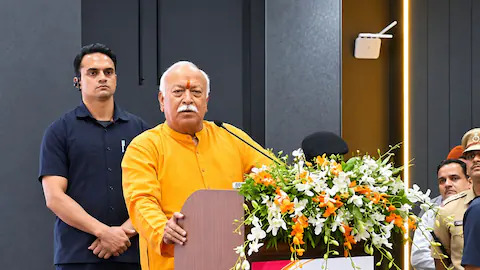
Rashtriya Swayamsevak Sangh (RSS) Sarsanghchalak Mohan Bhagwat made a significant statement in Nagpur on Monday, asserting that the Sangh has been functioning for 100 years—not through anyone’s patronage, but through the dedication of its volunteers (swayamsevaks). He made these remarks during the inauguration of the headquarters and auditorium of the Nagarik Sahakari Bank. Union Minister Nitin Gadkari was also present on the occasion.
Mohan Bhagwat stated that while it may not need to be explicitly mentioned, this event is, in itself, special. There are two programs today: the inauguration of a building and the release of a commemorative volume dedicated to the pracharaks (full-time volunteers). The thought that occurred to Nitin Gadkari also crossed my mind—that one represents a form of tapasya (dedicated penance/striving), while the other is its outcome. Today, we are experiencing both together.
Mohan Bhagwat shares a story
To illustrate his point, Mohan Bhagwat recounted an old story. He remarked that many in the audience might have heard it before—he himself had first heard it from someone else. It was a story often told by Shesh Ji. According to the tale, a king and his army once lost their way in a forest. While wandering, they arrived at a spot where a small hut stood, and a few ascetics were engaged in spiritual practice. The king explained that his group was exhausted and in need of food, water, and a place to stay. Noting the lack of such amenities at the site, he asked the ascetics where they might find them.
The ascetics directed them to a nearby forest, assuring them that everything they needed would be provided there. The king and his army went to the suggested location, where all their requirements were met. After resting for the night, they returned the next morning, feeling refreshed. The king asked the ascetics who had made those arrangements, to which they replied that they themselves had done so. The king then asked, “If you are capable of providing such facilities, why do you choose to live here in such simple, austere conditions?” The ascetics replied that they lived here in a state of simplicity and scarcity precisely so that they could ensure everything was prepared for people like the king.
Mohan Bhagwat noted that the founder of the Sangh had grasped this principle long ago. Having been an experienced worker involved in various initiatives for the nation’s progress, he had learned from his experience that if you improve the individual, everything else falls into place. It is for this reason that the RSS has, from its inception to the present day, focused its efforts on the process of ‘individual development’ (vyakti nirman).
Addressing the pace of deterioration and the pace of improvement
He noted that the Sangh has completed 100 years and continues to move forward today. This has been made possible not through anyone’s favor, but due to the efforts and dedication of the swayamsevaks (volunteers). We must work with urgency, as we are in a race against time. We need to move forward by striking the right balance between the pace of deterioration and the speed of improvement. To this end, every swayamsevak contributes in some capacity—dedicating time and shaping their life accordingly. Bhagwat explained, “Swayamsevaks contribute in two ways. Even those who are unable to dedicate time contribute by fostering a positive environment through their own lives and conduct.”
Bhagwat spoke at length about the lives of pracharaks (full-time dedicated workers). He observed that while human beings vary in their temperaments, levels of capability, and individual qualities, there is one common, defining feature: their dedication. He remarked, “As for us—well, I myself am a pracharak. You have seen—and continue to see—pracharaks; after 100 years, this has simply become the norm. It has reached a point where pracharaks naturally emerge.”
Books Being Written About Pracharaks After 100 Years
Mohan Bhagwat remarked that his responsibilities often take him abroad, including to so-called ‘developed’ nations. In those societies—which are highly organized, knowledgeable, and capable—people are often left astonished: how are individuals like these nurtured within the Sangh? They receive no material reward, yet for a hundred years, people have been working—individuals of all ages, some even dedicating their entire lives—without ever receiving a word of thanks.
The Sangh chief noted that while books about pracharaks (full-time Sangh volunteers) are now being written after a century, this was never something any pracharak expected—nor would they ever expect it—given that there is no personal gain to be had. If something happens to come their way, it is merely a matter of chance. Furthermore, those who write these books do so out of a sense of affection and gratitude toward the people they have worked alongside. While the books themselves are one outcome, the authors’ primary motivation is the belief that such lives should be brought to the public eye. For a pracharak, there is nothing—there is only the Sangh; the Sangh is everything, and nothing else exists. This is their state of mind. Because they work with such dedication, a natural sense of reverence arises toward them. It is out of this gratitude and affection that this book has come into being.