

 By
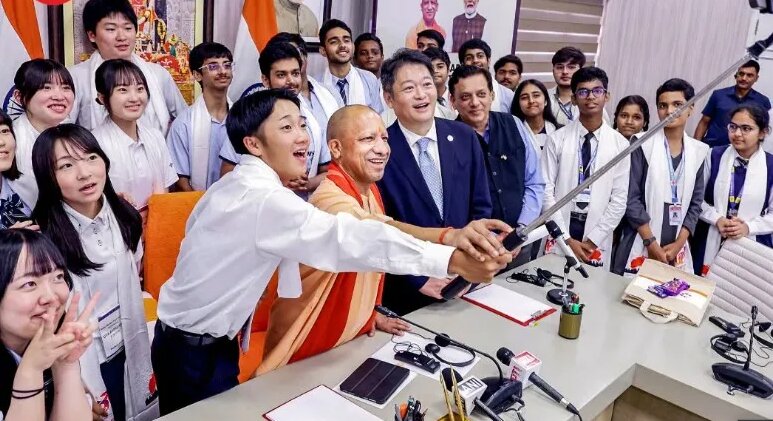
By A brief interaction between Uttar Pradesh Chief Minister Yogi Adityanath and a group of Japanese schoolchildren recently drew attention online, not because of any major policy announcement, but because of its simple and spontaneous warmth. A video showing the chief minister smiling and taking selfies with the children offered a very different picture from the formal exchanges normally associated with political and diplomatic meetings.
The interaction came against the backdrop of growing ties between Uttar Pradesh and Japan, with investments, industrial corridors, green hydrogen and the proposed Japan City forming part of the broader conversation. Yet, the most memorable moment was far less formal: Japanese children comfortably interacting with a saffron-clad Indian monk and political leader, with Yogi himself holding the selfie stick and joining in the photographs.
A moment beyond politics and diplomacy
International relationships are often measured through agreements, investments and government-to-government cooperation. But cultural familiarity can sometimes create a connection that needs neither a formal protocol nor a common language.
The interaction between Yogi and the Japanese children offered one such example. The children were meeting not only a chief minister but also a religious figure whose saffron robes represent a distinctly Indian spiritual tradition.
That cultural element may have made the encounter particularly natural for the Japanese students.
Why a monk may feel familiar to Japanese children
Buddhist traditions have been deeply woven into Japanese society for centuries. Buddhist temples have traditionally served not only as places of worship but also as community spaces, where people gather for religious ceremonies, family occasions and important moments of life.
For many Japanese families, therefore, Buddhist priests are not necessarily distant or unfamiliar figures. In several traditions, priests have also been part of ordinary family and community life.
The Indian understanding of a saffron-clad sanyasi is somewhat different. In India, saffron is strongly associated with renunciation and stepping away from worldly attachments. A sanyasi is consequently often viewed with a sense of reverence and distance.
The Japanese children’s response to Yogi appeared to carry a different kind of familiarity. Rather than treating him as a distant public figure, they interacted with him naturally and without hesitation.
Children changed the tone of the encounter
The exchange became even more striking because the children appeared relaxed around the chief minister. Their interaction was informal, friendly and largely free of the hierarchy normally associated with meetings involving political leaders.
Yogi also appeared comfortable with the spontaneity. He smiled throughout the interaction, helped organise the selfies and responded warmly to the children. At one point, a child even placed an arm around his shoulder, an informal gesture that the chief minister received with amusement.
It was a small moment, but it changed the character of the encounter from a formal political meeting into a genuine human interaction.
Cultural familiarity can cross language barriers
The episode also highlights how cultural understanding can sometimes work independently of language.
India and Japan have developed relations across several areas, including business, infrastructure, technology and education. But beneath those institutional relationships are centuries of cultural exchanges and shared influences, particularly through Buddhism.
The interaction in Uttar Pradesh showed how those deeper connections can surface unexpectedly. Instead of being built around speeches or diplomatic protocol, this particular moment revolved around smiles, children and a selfie stick.
Yogi’s public identity extends beyond politics
Yogi Adityanath’s public image has also been shaped by his life as a religious leader. His association with the Gorakhnath tradition predates his political career and has brought him into contact with people from different sections of society.
That background gives his public persona a dimension that goes beyond his role as chief minister. While political leaders are generally assessed through their policies and positions, religious and cultural identity can also influence how people from other societies perceive them.
For Japanese children familiar with Buddhist traditions, a monk in saffron robes may carry a cultural meaning that differs from the way an Indian political audience sees the same figure.
An unscripted moment amid expanding ties
The viral interaction may ultimately be remembered less for its political significance and more for what it revealed about everyday cultural connection.
As Uttar Pradesh and Japanese institutions continue to deepen their economic and institutional engagement, such informal moments can provide another window into the relationship between the two societies.
The children did not appear concerned about political office or power. They responded to the person in front of them—and Yogi responded in kind.
For a few moments, there was no speech, policy announcement or diplomatic choreography. There was simply a group of children, a monk in saffron robes and a chief minister who could not stop smiling.