
 By
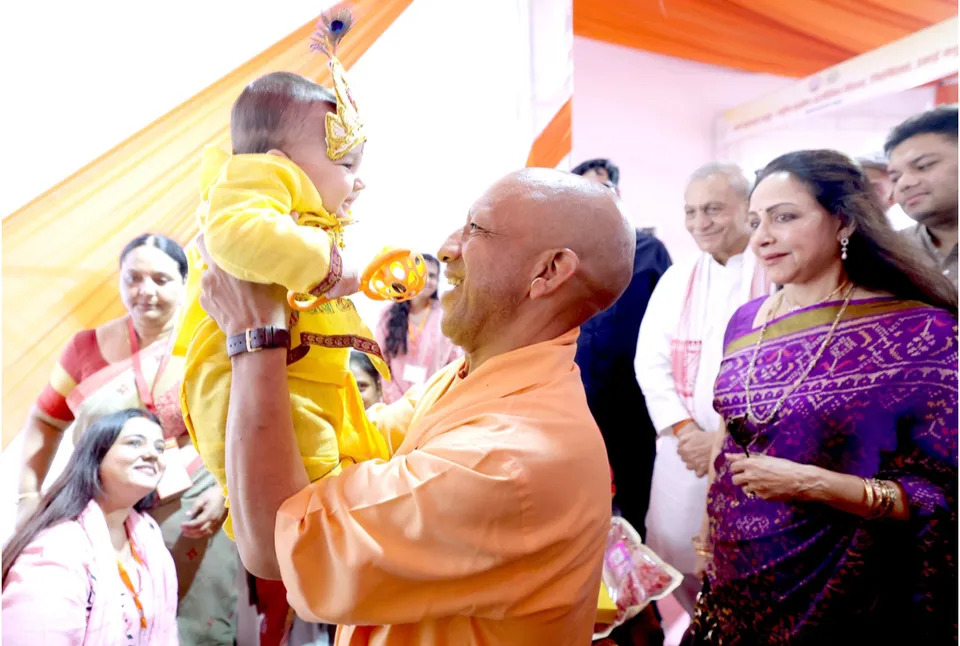
By Uttar Pradesh Chief Minister Yogi Adityanath on Thursday marked Krishna Janmashtami in the Braj region by inaugurating and laying the foundation stones for 229 development projects worth ₹1,051 crore. The projects span infrastructure, tourism and public facilities, with the government also transferring more than ₹72 crore directly to beneficiaries under a housing scheme.
Speaking from the land associated with Lord Krishna, Adityanath placed heritage and development at the centre of his address. He said Uttar Pradesh’s approach to development now combines better infrastructure with the preservation of its religious and cultural identity. The projects included the Swami Shri Haridas Auditorium at the Gita Research Institute and Rasleela Academy in Vrindavan, among other initiatives.
229 projects worth ₹1,051 crore
Of the projects announced, 62 projects worth more than ₹540 crore have been inaugurated, while foundation stones were laid for another 167 projects costing over ₹437 crore.
The chief minister also highlighted the transfer of more than ₹72 crore to beneficiaries under housing-related assistance, describing welfare delivery as an important part of the state’s broader development agenda.
Braj’s heritage at the centre of development
Adityanath used the occasion to underline the importance of preserving the cultural identity of Mathura, Vrindavan, Barsana, Govardhan and surrounding areas.
Referring to Swami Haridas, he said the saint gave devotional expression to music and helped establish Braj as an important centre of spiritual and musical traditions. He also recalled Swami Haridas’s connection with the legendary musician Tansen.
The chief minister argued that development should not be measured only through roads, electricity, water supply, buildings and industries. In his view, preserving temples, traditions, literature, music, art and historical figures is equally important to the development of a society.
‘Faith and heritage cannot be erased’
Adityanath cited Mathura, Ayodhya and Kashi as examples of places where religious traditions continued despite historical upheavals.
He said repeated attacks on temples did not eliminate the traditions associated with them, pointing to the continued observance of festivals and religious practices in Braj and Ayodhya.
“Foreign invaders may have demolished temples, but they could never shake our devotion,” he said, while highlighting what he described as the continuity of Sanatan traditions.
He also referred to the reconstruction of the Kashi Vishwanath Temple and the development of the Ram temple in Ayodhya as examples of the revival of India’s religious heritage.
Development linked with security and connectivity
The chief minister said large-scale tourism and investment depend on people feeling secure. He linked improved law and order with the growing number of visitors to Uttar Pradesh.
According to Adityanath, 156 crore tourists visited Uttar Pradesh last year, reflecting the state’s expanding religious and tourism economy.
He also pointed to the participation of crores of Kanwar pilgrims during the Sawan season and said the government was focused on ensuring that religious events could take place with adequate security and civic arrangements.
Braj receives major tourism push
Adityanath said the Braj Teerth Vikas Parishad has completed projects worth around ₹1,000 crore over the past eight years.
Development work is being undertaken across Vrindavan, Barsana, Nandgaon, Govardhan, Radha Kund, Gokul, Baldev and Mathura, he said. The government is also working on the 84-Kosi and Panchkosi Parikrama routes and restoration of traditional kunds.
The chief minister mentioned several major projects intended to improve the visitor experience, including the proposed ropeway in Vrindavan, mega parking facilities and the Raya Urban Node in Mathura.
He also said development around the Shri Banke Bihari Temple would receive a major boost if the necessary permission is granted by the Supreme Court.
Preserving Brajbhasha and cultural traditions
The government is also focusing on protecting the region’s language and artistic heritage. Adityanath said the Surdas Brajbhasha Academy had been established to preserve Braj culture and promote Brajbhasha.
He added that artists from India and abroad would be brought together to showcase Braj’s musical and literary traditions on a wider platform.
Another major initiative is the development of Saubhari Van, described by the chief minister as Asia’s largest City Forest. The project is being developed across about 400 acres within the urban limits of Vrindavan.
Heritage as part of modern Uttar Pradesh
Adityanath said Uttar Pradesh’s transformation should include both modern infrastructure and a stronger connection with its historical and cultural roots.
He highlighted pilgrimage centres including Ayodhya, Kashi, Mathura, Vrindavan, Barsana, Govardhan, Nandgaon, Baldev, Vindhyachal, Chitrakoot, Shukteerth, Sambhal, Naimisharanya, Sarnath and Kushinagar as part of the state’s wider cultural development strategy.
He said the objective was to create an Uttar Pradesh where heritage, faith, tourism, investment and modern infrastructure develop alongside each other, while ensuring opportunities for women, youth, farmers, entrepreneurs, artisans and other sections of society.