
 By
By Delhi’s air quality deteriorated further on Saturday, edging dangerously close to the ‘severe’ category as the city’s overall Air Quality Index (AQI) rose to 387, undoing the brief improvement seen earlier in the week.
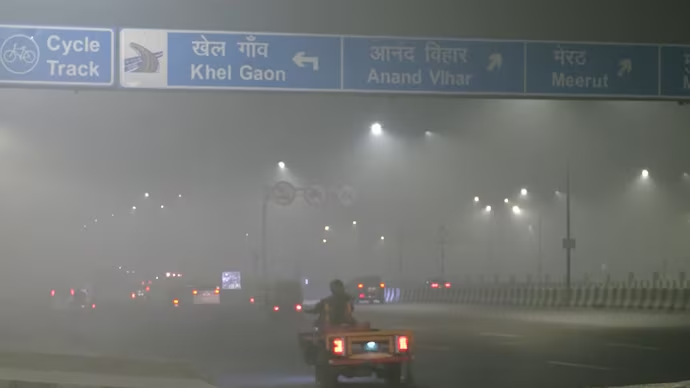
Thick smog mixed with shallow fog enveloped several parts of the capital during the early morning hours, sharply reducing visibility and prompting the implementation of low-visibility procedures at Indira Gandhi International Airport. However, airport officials said flight operations remained unaffected.
Pollution hotspots were hit the hardest, with 18 areas recording AQI levels above 400, signalling hazardous air quality. Wazirpur topped the list with an AQI of 443, followed by Jahangirpuri (439), Vivek Vihar (437), Rohini and Anand Vihar (434 each), Ashok Vihar (431), and Sonia Vihar and DTU (427 each). Several other localities, including Narela, Bawana, ITO, Punjabi Bagh, Chandni Chowk and Delhi University’s North Campus, also slipped into the ‘severe’ category.
After nine straight days of ‘very poor’ air, Delhi had seen a marginal respite earlier this week when the AQI dropped to 282 on Tuesday and 259 on Wednesday. However, conditions worsened again to 307 on Thursday and 349 on Friday, according to CPCB data.
The pollution crisis mirrored across the NCR, with Ghaziabad and Noida recording AQI levels of 422 each. Gurugram and Faridabad remained in the ‘poor’ category.
The India Meteorological Department (IMD) said visibility in Delhi dipped to around 500 metres and warned that dense fog is likely to persist over the next two days due to low wind speeds, high moisture levels and the absence of active western disturbances. These unfavourable conditions have trapped pollutants close to the ground, worsening air quality.
Authorities have urged residents to limit outdoor activities as hazardous conditions continue across Delhi-NCR.