
 By
By Amit Shah Announces Three-Year Nationwide Anti-Drug Campaign from March 31
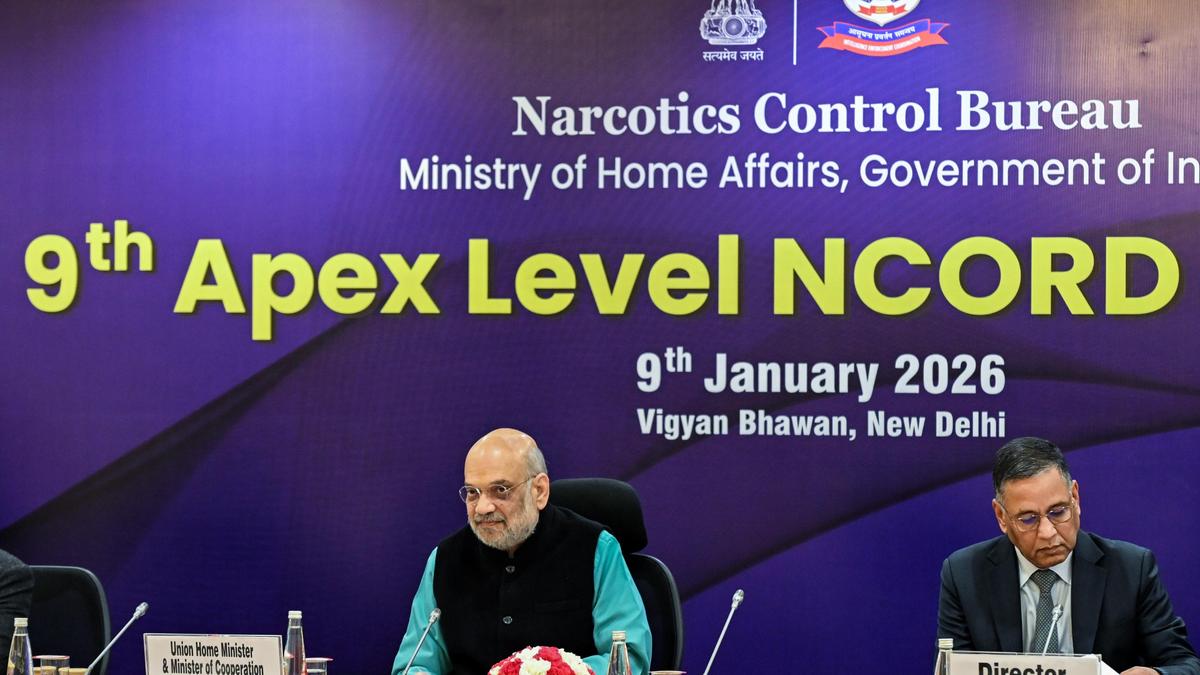
New Delhi: Union Home Minister Amit Shah on Friday (January 9, 2026) announced a three-year nationwide campaign against narcotics, set to begin from March 31, with the aim of eliminating the drug menace from India and protecting the country’s youth.
Addressing the 9th apex-level meeting of the Narco-Coordination Centre (NCORD), Shah said the campaign will adopt a structured, time-bound, and outcome-driven approach. As part of the initiative, a common working methodology will be defined for all stakeholders, clear targets will be set, and periodic reviews will be conducted to ensure accountability.
The nationwide anti-drug drive will be launched immediately after the March 31 deadline set by the Centre to eliminate Naxalism, Shah said. He emphasised that the fight against drugs must be treated as a national priority and carried out on all fronts simultaneously.
During the event, the Home Minister also virtually inaugurated a new Narcotics Control Bureau (NCB) office in Amritsar. The hybrid-mode meeting, organised by the NCB, was attended by senior officials from central ministries and departments, representatives of state governments, and drug law enforcement agencies, according to an official statement.
Shah directed all concerned departments to prepare a comprehensive roadmap by March 31 to tackle the drug problem, establish a robust monitoring mechanism, and focus exclusively on achieving measurable outcomes. He stressed that only a coordinated and sustained effort could deliver a long-term solution.
“In the next three years, we must fight against drugs across the country with full force and work towards making India drug-free. Protecting our youth from drugs is our foremost responsibility,” Shah said.
Highlighting the importance of prevention, the Home Minister said continuous awareness is critical and that the government aims to create a permanent and institutionalised system capable of combating drug abuse effectively.
Shah reiterated that the government’s policy is unambiguous and that no leniency should be shown towards those involved in the manufacturing, trafficking, or sale of narcotics. At the same time, he underlined the need for a humanitarian approach towards victims of drug addiction, focusing on rehabilitation and harm reduction.
He further instructed all central government departments to prepare action plans extending up to 2029 and establish a time-bound review framework to track implementation. State Directors General of Police (DGPs) were also urged to formulate state-specific roadmaps and ensure the timely destruction of seized narcotics.
Also Read – West Bengal CM Mamata Banerjee Visits I-PAC Co-Founder’s Home, Office During ED Raids
Linking the fight against drugs to national security, Shah said the challenge is closely associated with narco-terrorism rather than being merely a law-and-order issue. He described the drug trade as a deliberate conspiracy aimed at destroying future generations and weakening society.
“The health, productivity, and mental well-being of our youth, as well as rising social discontent, are directly linked to this problem,” he said.
Citing data, Shah said that from 2004 to 2013, drugs weighing around 26 lakh kilograms worth ₹40,000 crore were seized, while between 2014 and 2025, seizures rose to 1.11 lakh kilograms valued at ₹1.71 lakh crore, reflecting an 11-fold increase in the value of drugs confiscated. He added that opium crops destroyed increased from 10,770 acres in 2020 to 40,000 acres by November 2025.
Shah said India will move forward with a three-pronged strategy comprising a ruthless approach against the drug supply chain, a strategic focus on reducing demand, and a humane framework for harm reduction. Strengthening command, compliance, and accountability across institutions will be key to achieving a drug-free India, he added.
He also stressed that performance assessments should focus on outcomes rather than the number of meetings held, with strict action against kingpins, financiers, and logistics networks of the drug trade. Increased use of forensic science laboratories, faster filing of chargesheets, and higher conviction rates were identified as critical targets.
The NCORD mechanism, established in 2016, operates through a four-tier structure involving apex-level, executive-level, state-level, and district-level committees. It aims to enhance coordination among states, the Ministry of Home Affairs, and other stakeholders to address the drug menace in a comprehensive and integrated manner.