
 By
By
Exit polls point to BJP–Shiv Sena dominance in Mumbai civic polls, opposition struggles to convert alliance into votes
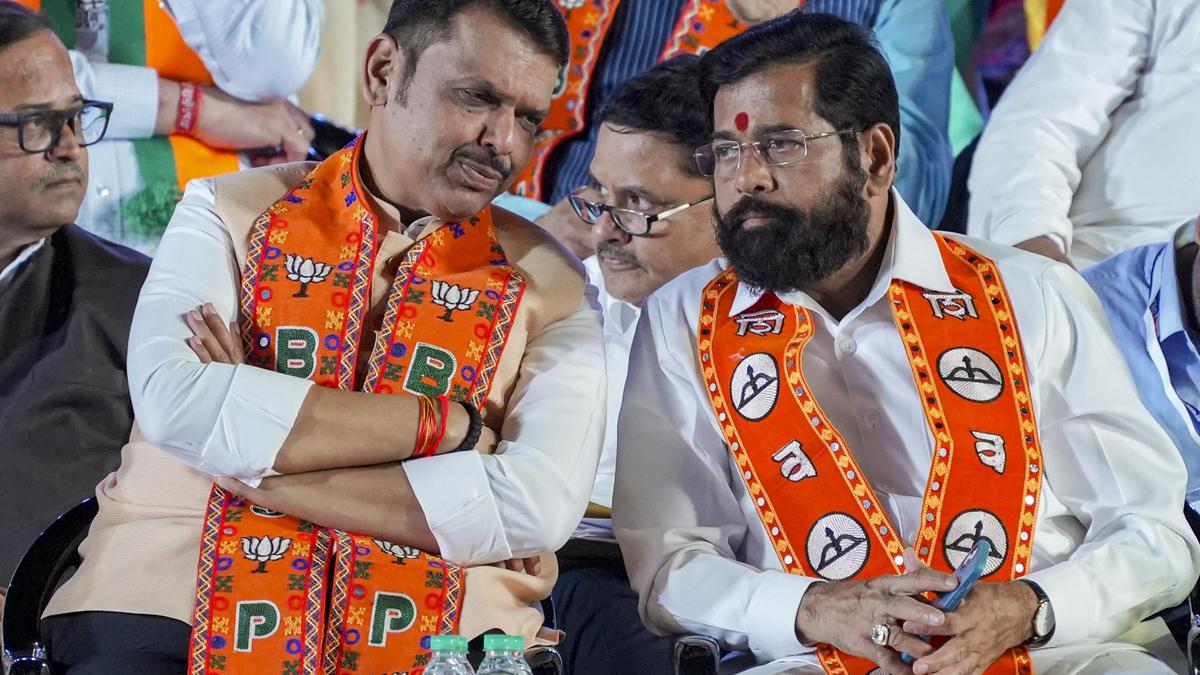
Exit polls for Maharashtra’s high-stakes civic elections indicate a decisive advantage for the BJP–Shiv Sena alliance, particularly in Mumbai, where control of the Brihanmumbai Municipal Corporation (BMC) has long been seen as both a political trophy and a financial powerhouse. Voting for the civic bodies concluded on January 15, and multiple exit poll agencies suggest that the ruling alliance is set to reclaim firm control over the country’s richest municipal corporation after years of political uncertainty.
The projections mark a critical moment in Maharashtra politics, where local body elections are being viewed as a referendum on the post-2022 political realignment of Shiv Sena and the broader acceptance of the BJP-led coalition’s governance narrative. While the opposition stitched together an unusual alliance involving the Shiv Sena (UBT), Maharashtra Navnirman Sena (MNS) and NCP (Sharad Pawar faction), early indicators suggest that the consolidation of votes did not translate into a corresponding consolidation of seats.
Mumbai: Numbers favour the ruling alliance
According to the My Axis India exit poll, the BJP–Shiv Sena alliance is projected to win between 131 and 151 seats in the 227-member BMC, comfortably crossing the majority mark. The alliance is expected to secure around 42 per cent of the total vote share, reflecting strong support across several middle-class and Marathi-dominated wards, as well as growing traction in traditionally mixed localities.
In contrast, the Shiv Sena (UBT)–MNS–NCP (SP) combine is estimated to win 58 to 68 seats with a vote share of about 32 per cent. Despite the symbolic coming together of Uddhav Thackeray and Raj Thackeray, the alliance appears to have struggled with vote transferability at the ground level, particularly in seats where organisational overlap and cadre coordination remained weak.
The Congress-led grouping, which included the Vanchit Bahujan Aghadi and Rashtriya Samaj Paksha, is projected to secure between 12 and 16 seats, with roughly 13 per cent of the vote share. Independents and smaller parties, including AIMIM and Left groups, are expected to divide the remaining seats.
Saam TV and Jubilant polls reinforce trend
The Saam TV exit poll paints a similar picture, projecting the BJP as the single largest party in Mumbai with around 84 seats, while its ally Shiv Sena is likely to win approximately 35. Together, this places the alliance well ahead of the opposition.
Under this projection, the Shiv Sena (UBT) could secure around 65 seats, while the MNS may be limited to about 10. The NCP (SP), despite being part of the opposition front, is expected to make only marginal gains in Mumbai, highlighting its limited organisational presence in the city.
Jubilant Data Studio’s exit poll offers a broader range but arrives at the same conclusion: the BJP–Shiv Sena alliance is likely to win between 127 and 155 seats in the metropolis. The opposition alliance could be restricted to 44–64 seats, while the Congress-led front may settle between 16 and 25 seats.
Read More – “Batenge To Katenge”: Uddhav and Raj Thackeray Unite for Mumbai Civic Polls
Pune and Thane show contrasting dynamics
Beyond Mumbai, the exit polls suggest that the BJP remains the dominant force in Pune, Maharashtra’s second-largest civic body. Saam TV projects the BJP to win around 70 seats, followed by the NCP with about 55. Smaller parties, including Shiv Sena factions, Congress, and MNS, are expected to play a limited role in the final tally.
Jubilant Data Studio estimates an even stronger performance for the BJP in Pune, projecting between 79 and 92 seats. The NCP is expected to remain the principal challenger, while other parties may struggle to reach double digits. The results point to Pune voters prioritising continuity in urban infrastructure and governance over alliance experimentation.
In Thane, long considered a bastion of Deputy Chief Minister Eknath Shinde, the exit polls indicate a commanding performance by the Shiv Sena–BJP combine. Saam TV predicts that the Shiv Sena could secure around 72 seats, with the BJP adding another 26. The opposition is projected to remain largely marginal, with limited seat shares across Sena (UBT), MNS, and Congress.
Why the opposition alliance fell short
Political observers attribute the opposition’s underwhelming performance to multiple factors. While the Sena (UBT)–MNS alliance generated media attention, it struggled to overcome historical rivalries at the booth level. Cadre coordination issues, unclear leadership messaging, and the absence of a unified mayoral narrative appear to have hurt the alliance’s prospects.
In contrast, the BJP–Shiv Sena alliance ran a tightly coordinated campaign focused on civic issues such as infrastructure upgrades, flood mitigation, road connectivity, and municipal efficiency. The emphasis on stability and administrative continuity appears to have resonated with urban voters, particularly in Mumbai’s middle-income housing belts.
Political implications ahead
If the exit poll trends hold when results are declared, the outcome will significantly strengthen the BJP–Shiv Sena alliance ahead of the upcoming state assembly elections. Control of key civic bodies like Mumbai, Pune, and Thane would give the ruling coalition not only political momentum but also administrative leverage in Maharashtra’s urban centres.
For the opposition, the results may trigger fresh introspection over alliance strategy, leadership coherence, and grassroots mobilisation. The civic verdict, while local in nature, could shape the broader contours of Maharashtra politics in the months ahead.