
 By
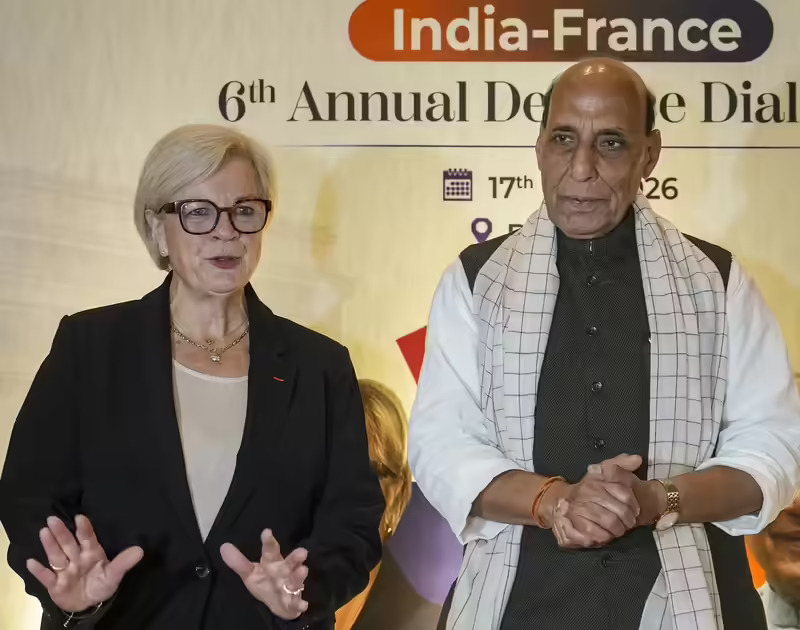
By India has sharpened its push for defence indigenisation in high-level talks with France, with Defence Minister Rajnath Singh urging a significant increase in locally manufactured components in the proposed 114-Rafale fighter jet deal. During the 6th India-France Annual Defence Dialogue held in Bengaluru, Singh pressed for raising the India-made share in the contract to as much as 50%, signalling New Delhi’s intent to turn one of its biggest fighter acquisitions into a manufacturing milestone.
According to defence sources, Singh conveyed to his French counterpart, Catherine Vautrin, that deeper localisation — including engine manufacturing and overhaul capabilities in India — would be critical to aligning the deal with the government’s ‘Make in India’ objectives. The proposed acquisition of 114 Dassault Rafale jets recently received preliminary approval from India’s Defence Acquisition Council, and formal negotiations are expected to gather pace in the coming months.
The talks extended beyond aircraft numbers and pricing. Singh emphasised that India seeks not just assembly lines but a transfer of critical technologies that would strengthen long-term maintenance, repair and overhaul (MRO) ecosystems within the country. A higher indigenous content threshold, officials say, would reduce lifecycle costs and build domestic aerospace capacity.
The defence dialogue also resulted in a 10-year renewal of the bilateral defence cooperation agreement between India and France. Both sides agreed to expand co-development and co-production initiatives, reflecting a strategic partnership that has steadily deepened over the past decade. Reciprocal deployment of army officers and enhanced joint exercises were among the measures announced.
In a parallel development, India and France signed a memorandum of understanding to manufacture Hammer precision-guided munitions in India. The project will be undertaken through a joint venture between Bharat Electronics Limited and French defence major Safran, marking another step toward expanding India’s role in high-value defence production.
Earlier in the day, Singh and Vautrin attended the inauguration of the H125 Light Utility Helicopter final assembly line at Vemagal in Karnataka. The facility, set up jointly by Tata Advanced Systems Limited and Airbus, was virtually inaugurated by Prime Minister Narendra Modi and French President Emmanuel Macron from Mumbai. The helicopter, capable of high-altitude operations including missions near Mount Everest, is expected to be delivered in its first India-made configuration by early 2027.
Modi described the helicopter programme as a symbol of India-France industrial cooperation moving from buyer-seller dynamics to collaborative manufacturing. Singh noted that the H125 project involves an investment exceeding ₹1,000 crore and is expected to generate both direct and indirect employment while supporting the armed forces’ light multi-role helicopter requirements, especially in Himalayan deployments.
President Macron, speaking alongside Modi, highlighted the expanding scope of defence collaboration — from Rafale jets and Scorpene submarines to helicopter assembly lines and advanced engine technologies. India is also considering the purchase of additional Scorpene-class submarines, having already inducted six under the Kalvari class programme.
Strategically, the Rafale negotiations represent more than an aircraft deal. By seeking up to 50% indigenous content and engine-related capabilities, India is attempting to anchor high-end aerospace manufacturing domestically. If accepted, the proposal could significantly elevate India’s position in the global defence supply chain while reinforcing France’s role as a long-term strategic partner.
As cost negotiations move forward and cabinet approval is awaited, the emphasis from New Delhi is clear: future defence acquisitions must not only strengthen combat capability but also accelerate India’s journey toward self-reliance in advanced military technologies.