
 By
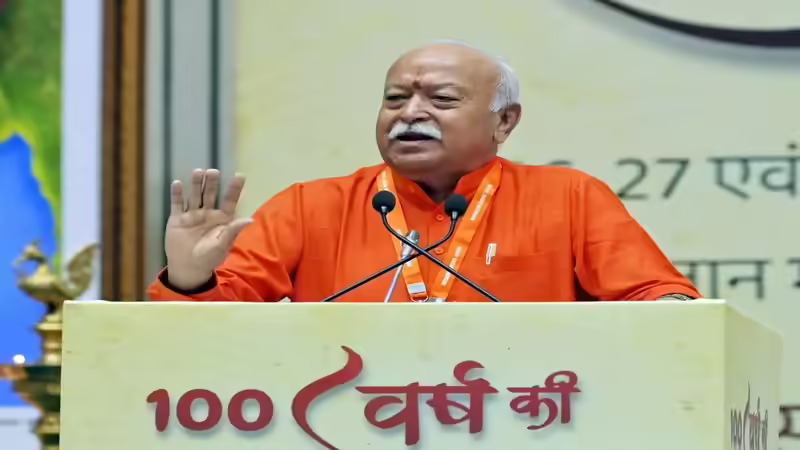
By Rashtriya Swayamsevak Sangh (RSS) chief Mohan Bhagwat has said that while the organisation is widely regarded as the world’s largest voluntary movement, it remains one of the most misunderstood institutions in public life. Speaking during an event linked to the RSS centenary celebrations, Bhagwat stressed that many perceptions about the Sangh are formed from a distance, without a proper understanding of its objectives and functioning.
As the RSS enters its 100th year, Bhagwat said the organisation has decided to actively engage with society and explain its work to a wider audience. According to him, the centenary year is not only a milestone for the Sangh but also an opportunity to bridge gaps in understanding and address misconceptions that have persisted over decades.
Addressing attendees at the event, Bhagwat remarked that people often interpret the RSS based on limited observations. He noted that some individuals view the organisation as a paramilitary body because of the uniformed route marches conducted by swayamsevaks, while others associate it primarily with physical activities, traditional games, and martial arts.
However, he argued that such impressions capture only a small part of what the organisation represents. “It is difficult to understand the Sangh from the outside,” Bhagwat said, adding that its true nature and purpose can only be appreciated through direct engagement.
The RSS chief suggested that the best way to understand the organisation is to participate in its activities and interact with its volunteers. While books, lectures, and public discussions may offer some insight, he said they can only provide a limited perspective. A deeper understanding, according to him, comes through personal experience and observation of how the organisation functions at the grassroots level.
Bhagwat also sought to clarify the historical foundation of the RSS. He said the organisation was not created as a reaction to any particular political event, community, or social group. Instead, he described it as a movement established with the broader objective of national service and social organisation.
The remarks come at a time when the RSS is marking a century since its founding in 1925. As part of the centenary outreach, the organisation has planned a series of public programmes, discussions, and interactions aimed at highlighting its history, ideology, and social initiatives.
According to Bhagwat, the Sangh’s continued focus remains on character-building, social harmony, and national development. He said the organisation’s efforts over the past hundred years have been guided by the goal of contributing positively to society and strengthening the nation’s social fabric.
With the centenary celebrations underway, RSS leaders appear keen to present the organisation’s work directly to the public, hoping that greater interaction will help people form opinions based on experience rather than perception.