 By
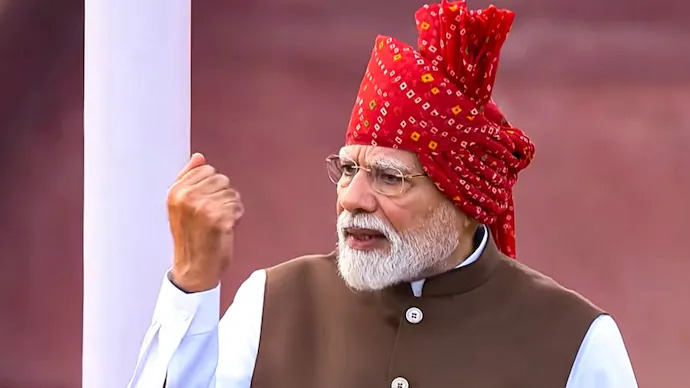
By Prime Minister Narendra Modi placed India’s young population and the aspirations of Gen Z at the centre of his Independence Day address, announcing new measures on artificial intelligence skills and competitive-exam preparation while calling on young Indians to play a leading role in building a developed India by 2047. His message came weeks after large student protests over examination irregularities, putting youth concerns firmly in the political spotlight.
From the Red Fort, Modi also laid out a broader roadmap for the country, combining his seven-point ‘Saptdhara’ framework with a renewed push for self-reliance in areas such as semiconductors, critical minerals and energy. At the same time, he warned against what he described as a new form of ideological threat, using the term “dimaagi naxal” to describe what he sees as efforts to influence or weaken the country from within.
The address also carried a significant political message on women’s representation. With the women’s reservation issue still facing political disagreement, Modi appealed to the Opposition to set aside differences and work towards implementing 33% reservation for women in Parliament and state assemblies.
Key Takeaways From PM Modi’s Independence Day Speech
1. Youth and Gen Z take centre stage
Youth emerged as one of the strongest themes of Modi’s roughly 75-minute speech. The Prime Minister announced plans to train one crore young Indians in artificial intelligence skills, alongside a proposal for free online coaching for competitive examinations.
The coaching initiative, he said, would particularly help students from poor and middle-class families who often face the financial burden of expensive preparation programmes.
“Yuva Shakti” was presented as a key force behind India’s journey towards becoming a developed nation. Modi stressed that young people would not merely benefit from India’s growth but would be among those driving it.
The focus on youth also comes against the backdrop of recent student protests linked to allegations of examination irregularities and concerns over employment. With a large share of India’s population below the age of 35, young voters are likely to remain an increasingly important political constituency in the years ahead.
2. Seven-point ‘Saptdhara’ roadmap
Modi also introduced the ‘Saptdhara’ vision, a seven-point framework aimed at providing a broader direction for India’s development journey.
The roadmap is intended to bring different priorities of national development together rather than treating economic growth, technology, social progress and self-reliance as separate goals.
The Prime Minister linked the framework to the larger ambition of creating a ‘Viksit Bharat’ by 2047, when India will mark 100 years of independence.
3. Fresh push for Atmanirbhar Bharat
Self-reliance remained another important element of the speech. Modi highlighted sectors that have strategic importance for India’s future, including semiconductors, critical minerals and energy security.
The emphasis reflects the government’s broader effort to reduce dependence on foreign supply chains in areas considered crucial for India’s economic and national security.
The Prime Minister’s message was that India must strengthen domestic capabilities while expanding its role in global manufacturing and technology.
4. Women’s reservation gets political focus
Modi also used the Independence Day platform to renew his appeal for greater political representation for women.
Amid the continuing political deadlock over the women’s quota issue, he called on the Opposition to move beyond differences and work towards 33% representation for women in Parliament and state legislatures.
The issue adds another significant political dimension to an address otherwise heavily focused on youth, economic transformation and national self-reliance.
5. Warning over ‘dimaagi naxal’
Another striking feature of the speech was Modi’s warning about what he called “dimaagi naxal”, or a form of ideological extremism that he suggested could pose a different kind of challenge to the country.
The reference broadened the Prime Minister’s discussion of national security beyond conventional threats, placing emphasis on the influence of ideas and narratives that he believes can undermine India’s development and unity.
Overall, Modi’s Independence Day address combined a strong youth-focused message with a wider political and economic roadmap. From Gen Z and AI skills to Saptdhara, women’s representation and self-reliance, the speech sought to connect the government’s long-term vision for Viksit Bharat 2047 with some of the immediate concerns shaping public debate in 2026.