
 By
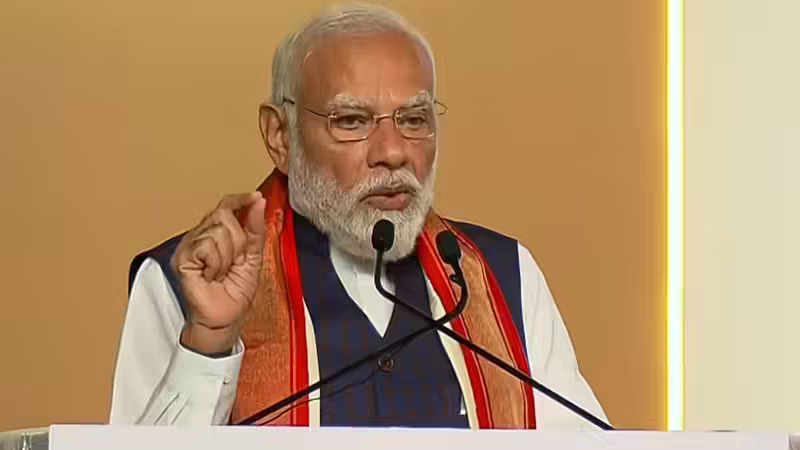
By Prime Minister Narendra Modi said developing countries are being unfairly burdened with responsibility for global carbon emissions, arguing that India’s per-capita emissions remain below the global average while emissions in developed countries are substantially higher. He made the remarks while inaugurating the International Conference on “The Future of Environment and Climate Dynamics” in New Delhi.
Addressing the gathering, Modi said the climate debate should take historical realities and differences in per-capita emissions into account. Referring to representatives from the Global South attending the conference, he said India’s per-capita carbon emissions are less than half the global average, while the figure in developed countries is about six times India’s level. He said India has consistently raised this point on international platforms.
Modi also referred to the 2015 Paris climate conference, or COP21, where India pushed for greater recognition of the differing responsibilities of developed and developing nations. He said India has subsequently continued working towards its climate commitments and claimed that it is the only G20 country to have achieved all the commitments it made at COP21 ahead of schedule.
The Prime Minister said India’s climate strategy is not limited to reducing emissions but also involves expanding renewable energy, improving energy efficiency and reducing dependence on fossil fuels. He highlighted initiatives such as the International Solar Alliance, the Global Biofuel Alliance, Mission LiFE and the “One Sun, One World, One Grid” vision as examples of India’s efforts to promote international cooperation on climate and energy.
Modi pointed to the rapid expansion of India’s solar power capacity as one of the country’s major changes in the energy sector. According to figures cited by him, India’s solar capacity has grown from around 2 gigawatts 12 years ago to more than 160 gigawatts today.
He also highlighted the Pradhan Mantri Surya Ghar Muft Bijli Yojana, saying rooftop solar systems have been installed in more than five million homes. The government, he said, provides financial assistance of up to ₹80,000 per household under the programme. Under the PM-KUSUM scheme, solar pumps have also been installed to support farmers, with Modi putting the figure at around three million farmers.
The Prime Minister said energy-efficiency measures, including the widespread use of LED bulbs, had also helped reduce electricity consumption and claimed that the combined impact of such initiatives had prevented around 20 crore tonnes of carbon emissions.
Alongside renewable energy, Modi highlighted India’s growing focus on hydropower and nuclear energy. He said the government is working to expand nuclear generation and has created a framework to allow private participation in the sector. He also pointed to efforts to promote cleaner coal technologies, including coal gasification.
Clean transportation was another focus of his address. Modi cited the growth of electric vehicles in India and said the country is also advancing work in green hydrogen. He referred to India’s first green hydrogen train as an example of the country’s push towards alternative fuels and cleaner mobility.
According to figures cited by the Prime Minister, electric vehicle sales have expanded dramatically over the past decade. He said fewer than 3,000 EVs were sold in India before 2014, compared with around 2.5 lakh units sold last year.
Modi also highlighted India’s expanding metro network, saying metro services now operate across more than 20 cities and the country’s combined metro network has crossed the 1,000-kilometre mark.
The Prime Minister said India’s approach to environmental protection is also influenced by its cultural traditions and long-standing ideas about living in harmony with nature. He called for international cooperation to address modern climate challenges while saying India is seeking to offer practical solutions through its experience in renewable energy, clean mobility and sustainable development.
The two-day international conference brings together participants from 17 countries. Chief Justice of India Surya Kant also addressed the inaugural session. Union Environment, Forest and Climate Change Minister Bhupender Yadav, Attorney General for India R. Venkataramani and National Green Tribunal Chairperson Justice Prakash Shrivastava were also present.