 By
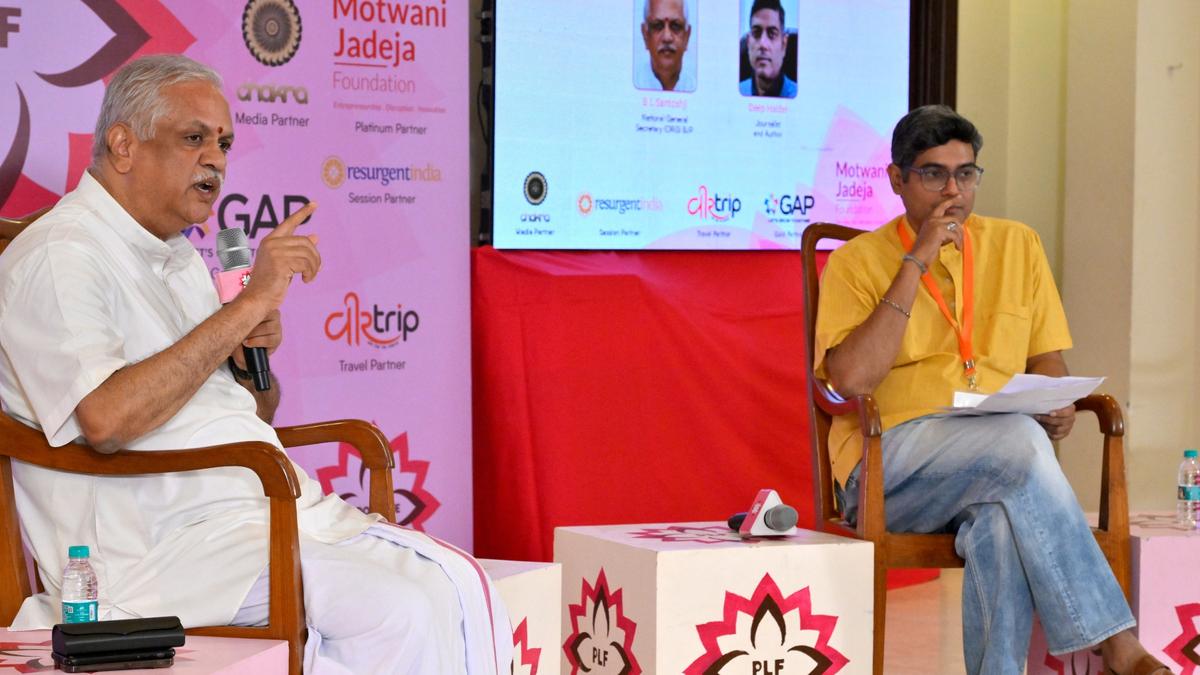
By Puducherry: The Rashtriya Swayamsevak Sangh’s ability to survive, expand and maintain its organisational presence for a century is one of its major achievements, BJP national general secretary B.L. Santosh said in Puducherry on Sunday. Speaking at a discussion on the RSS at 100, Santosh defended the organisation’s ideological approach and explained how he views its relationship with politics and broader social change.
Santosh was speaking at an interactive session titled “The RSS at 100” during the Bharat Shakti Pondy Lit Fest 2026. He said the RSS, founded in 1925, emerged at a time when Indian society was fragmented and, in his assessment, increasingly disconnected from its civilisational roots. According to him, the organisation sought to strengthen social cohesion around cultural values and create an environment where traditions it considers positive could continue to develop.
Santosh Challenges ‘Right-Wing’ Description of RSS
Santosh also questioned the use of terms such as “right-wing” and “centre-right” to describe the RSS. He argued that these labels originate largely from Western political frameworks and do not accurately capture the organisation’s ideological position in the Indian context.
He described the RSS as centrist within an Indian ideological framework, while stressing that this should not be understood as an attempt to position the organisation halfway between the political Left and Right.
On Caste Representation and Women’s Role
Responding to questions about allegations of Brahmin dominance within the RSS, Santosh said the social composition of local RSS units was influenced by the communities and networks from which its early members came. He rejected the suggestion that the organisation had a policy of excluding particular castes.
According to Santosh, leadership within the RSS can emerge from any community. He also addressed questions about the organisation’s shakha system, which was originally established for men, saying women participate as equal partners in social and nation-building activities.
RSS Position on Muslims, Christians and Communists
On the organisation’s approach towards Muslims, Christians and communists, Santosh said the RSS did not regard entire communities as threats. Instead, he said, its concerns were directed towards issues such as religious conversion, what he referred to as a “jihadi mindset” and intolerance.
His comments came amid a broader discussion about how the RSS defines social challenges and its engagement with different sections of society.
Santosh also described his own transition into electoral politics as having been sent on “deputation,” reflecting his long association with the RSS before taking on a prominent organisational role in the BJP.
‘Necessary Evil’ of Inducting Leaders From Other Parties
The BJP leader also defended the party’s decision to bring leaders from rival political organisations into its ranks. Responding to criticism over what has been described as “Trinamoolification” in West Bengal and “Congressification” in other parts of the country, he characterised such political moves as a “necessary evil” in pursuit of wider objectives.
Santosh argued that a legislative majority is often necessary to implement major reforms and respond to pressing challenges. Where the BJP lacks sufficient organic organisational growth, he said, bringing in political leaders from outside can help strengthen its position.
He also said the BJP had the organisational capacity to absorb and integrate newcomers.
Santosh Says RSS Continues to Engage Young People
Discussing Gen Z, Santosh cautioned against judging young people solely through social media trends or visible participation in protests. He said RSS camps continue to attract young participants.
He also described the promotion and wider acceptance of concepts such as Hindu Rashtra and Akhand Bharat as an ongoing process rather than a finished project.
RSS Activities in Nepal and Bangladesh
Santosh also spoke about the RSS’s activities beyond India’s borders. Regarding Nepal, he said the organisation was involved in non-political cultural and social initiatives aimed at preserving what he described as Hindu ethos and strengthening connections among Hindu, tribal and Buddhist communities.
On Bangladesh, he said the RSS had limited direct influence but supported Hindus through diplomatic channels, international organisations and contacts on the ground, while operating within the limits of international law.
Santosh Participates in Seva Sankalp Abhiyan
Earlier in the day, Santosh attended several programmes organised under the Seva Sankalp Abhiyan, an initiative of the BJP marking 25 years of Prime Minister Narendra Modi’s public service.
During his visit to Puducherry, he also met Chief Minister and AINRC founder N. Rangasamy.
The discussion at the literature festival provided Santosh an opportunity to reflect on the RSS’s century-long journey, its organisational expansion and its evolving relationship with politics, society and younger generations.