
 By
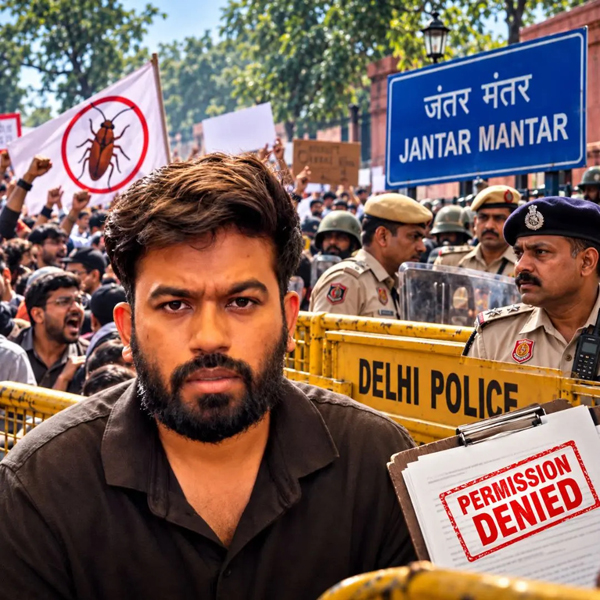
By The group said its founder, Abhijeet Dipke, and two other leaders, Saurav Das and Ashutosh Ranka, were detained after arriving on a flight from Mumbai on Saturday. The CJP claimed the three were taken to an undisclosed location. Delhi Police had not publicly commented on the reported detentions at the time of the report, and the group said it would continue its demonstration despite the restrictions.
CJP Challenges Restrictions on Delhi Protest
Security arrangements were tightened ahead of the demonstration, with barricades placed on roads and a large police presence across the city. Delhi Police had refused permission for the protest at Jantar Mantar, a prominent demonstration site in central Delhi.
Despite the restrictions, CJP maintained that protesters would gather. Ajinkya Shinde, named to lead the group while its other leaders remained in detention, urged supporters in a video message not to abandon the demonstration. He said that any place where police stopped protesters could become their Jantar Mantar.
Student activist Neha Bora, who was also reportedly detained, appealed to demonstrators to remain firm. Buses carrying detained protesters were seen leaving the protest area, while public announcements across the city asked people to cooperate with the police.
The security measures also affected transport. Several trains to and from major Delhi railway stations were reportedly cancelled, and dozens of metro stations were closed from Friday night.
Electoral Roll Revision at Centre of Dispute
The CJP is seeking the resignation of Chief Election Commissioner Gyanesh Kumar, accusing the Election Commission of manipulating voter lists. Opposition parties have raised similar allegations, claiming that the ongoing revision of electoral rolls could benefit Prime Minister Narendra Modi’s Bharatiya Janata Party (BJP).
The Election Commission has rejected allegations of political bias. It has described the nationwide exercise as a routine process intended to remove the names of deceased, duplicate and otherwise ineligible voters. However, the revision has sparked controversy in several states, where people have alleged that their names were wrongly removed from electoral rolls.
The dispute has added to broader concerns about election administration and voter access ahead of important state elections. The BJP and the Election Commission have denied claims that the process is being used to favour the ruling party.
How the ‘Cockroach’ Movement Began
The CJP emerged from a social media post by Dipke in May, after Chief Justice of India Surya Kant drew criticism for remarks comparing some unemployed young people to “cockroaches”. The judge later said his comments had been misinterpreted.
Dipke, who had previously worked with the opposition Aam Aadmi Party (AAP) and recently completed a master’s degree at Boston University, posted a question on X: “What if all cockroaches come together?” The post gained traction and became the starting point for the movement’s name and identity.
The group subsequently drew support around concerns including unemployment, examination paper leaks, education reforms and government accountability. It became more prominent during weeks of protests over education policy and demands for the resignation of Union Education Minister Dharmendra Pradhan.
In July, Dipke watched as a five-week protest campaign ended in celebrations following Pradhan’s resignation. The latest mobilisation in Delhi marks another phase in the group’s campaign, this time focused on electoral processes and the Election Commission.
Before travelling to Delhi, Dipke warned that threats of imprisonment would not deter the movement. Protesters also described the demonstration as a defence of democracy, even as police restrictions and detentions limited their ability to gather at the intended site.