
 By
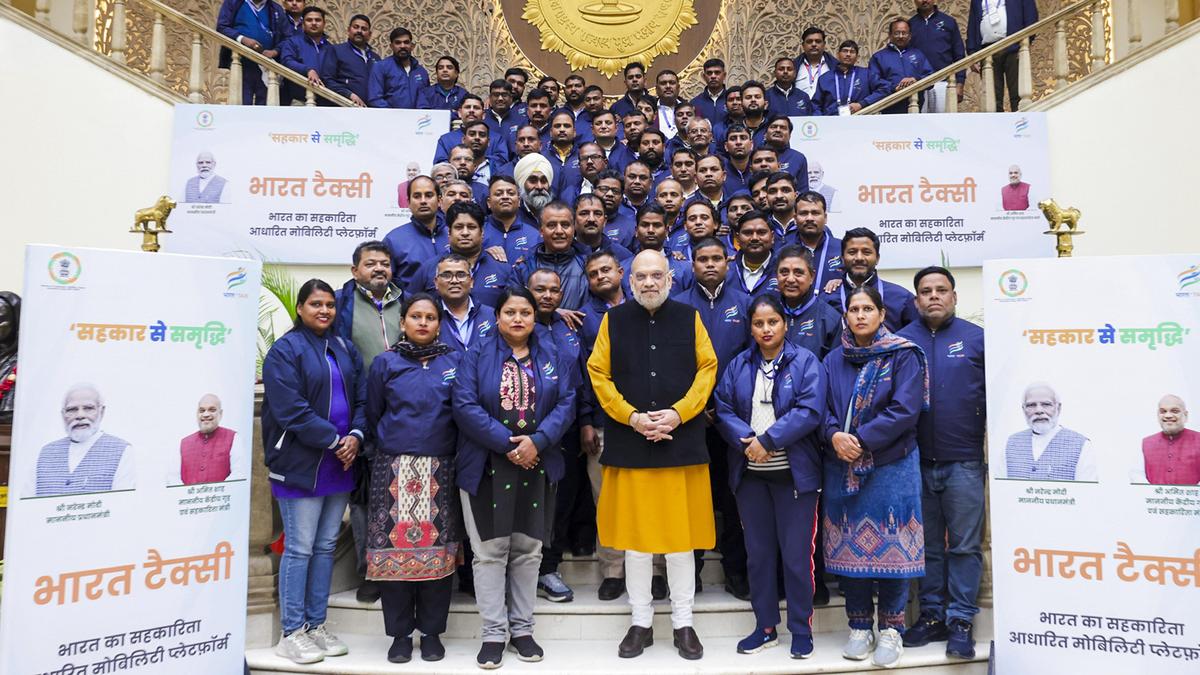
By In a move aimed at reshaping India’s ride-hailing industry, Union Home Minister Amit Shah on Monday announced that Bharat Taxi, a newly launched cooperative cab platform, will guarantee a minimum base fare per kilometre for every driver on its network. Addressing drivers from Delhi-NCR and Gujarat at a town hall interaction, Shah positioned the initiative as an alternative to profit-driven aggregator models that, he claimed, leave drivers vulnerable to fluctuating fares and shrinking earnings.
The promise of a fixed minimum rate marks a departure from the dynamic pricing systems used by private platforms, where fares often depend on demand algorithms. Shah argued that the absence of a guaranteed base fare allows companies to prioritise corporate margins over worker stability. “Those who toil the most should get the most profit,” he said, framing Bharat Taxi as a corrective to what he described as structural imbalances in the gig economy.
According to Shah, the cooperative model will distribute 80% of profits back to drivers based on the kilometres they drive, while 20% will be retained as capital for the platform’s expansion. However, he cautioned that profit redistribution will not be immediate. “It will take at least three years before profits begin to return in a substantial way,” he said, urging drivers to view the platform as a long-term investment rather than a short-term windfall.
Drawing parallels with the dairy cooperative Amul, Shah described Bharat Taxi as an attempt to replicate that success in the mobility sector. Just as small dairy farmers built Amul into a multi-crore enterprise through collective ownership, he said, drivers could gradually build equity in their own platform. Drivers can become co-owners by purchasing a share worth ₹500, and as membership expands, driver representatives will be given seats on the Board of Directors.
In addition to fare guarantees, Shah outlined structural reforms aimed at improving driver welfare. A three-tier grievance redressal mechanism — online, physical offices and call centres — will allow drivers to raise concerns, addressing a common complaint that existing apps prioritise passenger support. Policy changes on the app will be communicated at least a week in advance, he added.
The platform also introduces a ‘Saarathi Didi’ feature, enabling women passengers travelling alone to opt for women drivers. While acknowledging that such a choice could affect earnings distribution, Shah said promoting safety and employment opportunities for women was a collective responsibility.
Financial inclusion measures were also highlighted. Cooperative banks will facilitate vehicle loans using taxis as collateral, and insurance coverage will be provided through IFFCO Tokyo at negotiated rates.
Launched formally on February 5 after a pilot phase, Bharat Taxi began limited operations on January 1 in select cities, including Delhi. As the cooperative scales up, its success will depend not just on policy promises, but on whether drivers see sustained income stability in a market long dominated by private aggregators.