 By
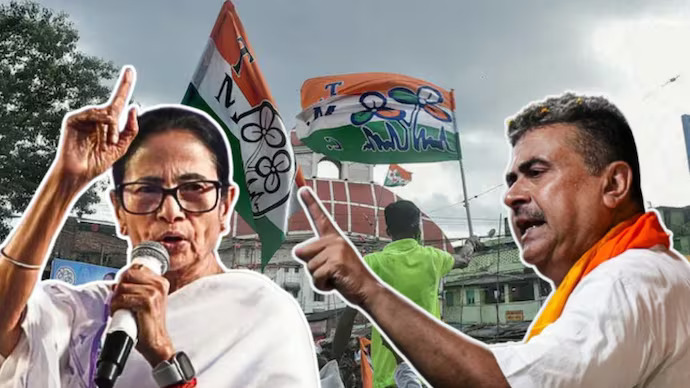
By As West Bengal heads toward another high-stakes Assembly election, Bhabanipur is emerging as more than just a constituency—it is fast becoming the centrepiece of a larger political strategy. The BJP’s decision to field Suvendu Adhikari against Chief Minister Mamata Banerjee has turned what was once considered her safe seat into a tightly contested arena.
The move appears calculated. By pushing Adhikari into Bhabanipur—while also retaining him in Nandigram, where he defeated Banerjee in 2021—the BJP is attempting to recreate a direct face-off that carries both symbolic and strategic weight. The idea isn’t just to win a seat; it’s to force Banerjee into a prolonged, high-pressure contest on her home turf.
For the BJP, Bhabanipur is not merely another urban constituency in Kolkata. It is the political anchor that allowed Mamata Banerjee to return as Chief Minister after her Nandigram loss in 2021. By elevating the contest here into a prestige battle, the party hopes to keep her occupied locally, limiting her ability to campaign extensively across the state’s 23 districts.
This matters because Banerjee remains the Trinamool Congress’ most influential campaigner. A constrained schedule in Bhabanipur could impact the party’s outreach in closely fought constituencies elsewhere. BJP leaders believe even forcing a tighter-than-expected contest could shift momentum in their favour.
Adhikari’s dual candidature adds another layer to the strategy. His 2021 victory over Banerjee in Nandigram gave the BJP a powerful narrative boost, and repeating that rivalry in Bhabanipur carries psychological overtones. A win here would not only be electoral but symbolic—challenging Banerjee in the very seat that secured her continuation in power.
Demographics could also play a crucial role. Bhabanipur has a diverse voter base, with a significant presence of non-Bengali communities—Gujaratis, Marwaris, Punjabis and Odias—alongside a sizeable Muslim population. While the seat has historically favoured the Trinamool Congress, the BJP sees an opportunity to consolidate support among sections of the non-Bengali electorate.
At the same time, recent developments such as the Special Intensive Review (SIR) of electoral rolls have added a new dimension to the contest. The reported deletion of thousands of names has sparked political controversy, with the Trinamool alleging irregularities and the BJP maintaining that the exercise targeted duplicate entries. The outcome of this dispute could influence voter dynamics in subtle but significant ways.
Despite the BJP’s aggressive positioning, Mamata Banerjee retains a strong organisational network in Bhabanipur. In the 2021 bypoll, she secured a comfortable victory margin, underscoring her grip over the constituency. However, this time the stakes are different. The BJP is not just contesting a seat—it is attempting to reshape the narrative of the entire election.
Whether this political “Chakravyuh” succeeds in containing Banerjee or is broken by her campaign machinery will only become clear once voters deliver their verdict. For now, Bhabanipur stands at the heart of West Bengal’s electoral battle, with both sides treating it as a defining contest.