
 By
By
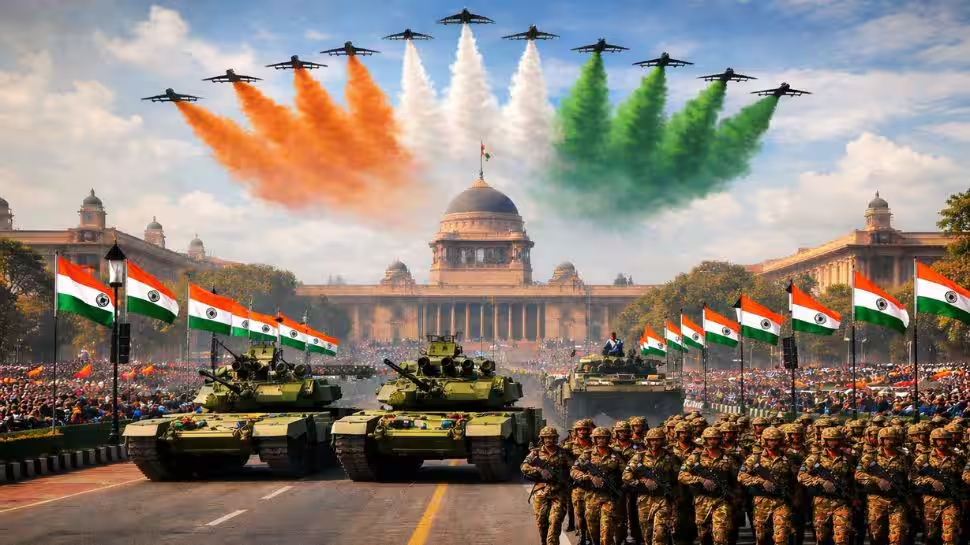
This year’s Republic Day parade on Kartavya Path was not just a ceremonial march-past—it was a carefully curated statement of India’s evolving military doctrine. Coming months after Operation Sindoor, the 2025 counterterror operation that reshaped regional security equations, the parade placed India’s frontline weapon systems and integrated warfare capabilities firmly in the national spotlight. The message was unmistakable: India is prepared, technologically advanced, and resolute in defending its sovereignty.
From the ground to the skies, the 77th Republic Day celebrations showcased how India’s armed forces have transitioned from platform-centric strength to networked, multi-domain combat readiness. As dignitaries from Europe, senior defence officials, and thousands of spectators watched, the parade blended tradition with modern warfare realities, reflecting a military confident in both deterrence and execution.
A Shift from Symbolism to Combat Readiness
One of the most striking features of this year’s parade was the debut of the Army’s ‘Battle Array’ formation. Unlike conventional ceremonial displays, the formation replicated a real-world battlefield configuration, signalling the armed forces’ shift towards integrated, combat-ready postures. It marked a departure from visual symbolism to operational realism, mirroring how modern conflicts demand speed, coordination, and technological superiority.
This emphasis was reinforced by a glass-encased Integrated Operational Centre (IOC) tableau depicting Operation Sindoor. Rolling down Kartavya Path, the IOC display offered a rare public glimpse into how India conducts joint military operations. It highlighted seamless coordination between the Army, Navy, and Air Force under unified command structures—an approach increasingly central to India’s defence strategy.
BrahMos and S-400: A Strategic Signal
At the heart of the tri-services tableau were two systems that have become synonymous with India’s deterrence posture: the BrahMos supersonic cruise missile and the S-400 air defence system. Their joint display underscored the concept of offensive precision backed by robust defensive shielding.
During heightened military tensions in May 2025, the S-400 system—described by defence planners as part of India’s “Sudarshan Chakra”—played a critical role in securing civilian and strategic assets. The BrahMos, meanwhile, demonstrated India’s capability to conduct swift, high-impact strikes deep into hostile territory, a capability that proved decisive during Operation Sindoor.
Operation Sindoor: A Defining Military Moment
Launched in response to the April 2025 terror attack in Pahalgam that claimed 26 lives, Operation Sindoor marked one of India’s most coordinated counterterror actions in recent years. Over 100 terrorists and enemy combatants were neutralised, critical infrastructure was dismantled, and hostile forces were pushed into operational paralysis within 88 hours.
A glimpse of India's victory in Operation Sindoor, showcasing the unified strength of the Indian Army, Air Force & Navy. 🇮🇳 pic.twitter.com/DSWTSNDaG2
— Piyush Goyal (@PiyushGoyal) January 26, 2026
The IOC tableau illustrated how political leadership, military commanders, and real-time intelligence converged to execute the operation. Equally highlighted was the role of civilian resilience and public support—factors increasingly recognised as vital in modern conflict environments.
Indigenisation and the Rise of Drone Warfare
Beyond missiles and air defence, the parade placed strong emphasis on India’s growing unmanned warfare capabilities. Combat Support Elements such as Shaktibaan and Divyastra, mounted on High Mobility Vehicles (HMV 6×6), reflected the Army’s push towards indigenous, technology-driven solutions.
These platforms integrate swarm drones, tethered surveillance systems, and the indigenously developed hybrid UAV ZOLT, which is used for directing artillery fire. Their effectiveness is further enhanced by loitering munitions like Harop, Mini Harpy, Sky Striker, and ATS variants, enabling persistent surveillance and precision strikes.
According to defence officials, these systems represent a decisive shift towards data-driven warfare, where situational awareness and rapid targeting can determine outcomes long before conventional troop engagement.
Virasat, Vividhta aur Vikas in Uniform
Anchored in the broader Republic Day theme of “Virasat, Vividhta aur Vikas,” the military displays captured how India’s armed forces are blending legacy strength with future-ready capabilities. The parade was not just a celebration of past achievements but a forward-looking demonstration of how India intends to secure its future—through preparedness, integration, and indigenous innovation.
As the final flypast roared over Raisina Hills, unfurling the Operation Sindoor flag midair, the symbolism was complete. India’s message to the world was calm yet firm: peace remains the goal, but readiness is non-negotiable.