 By
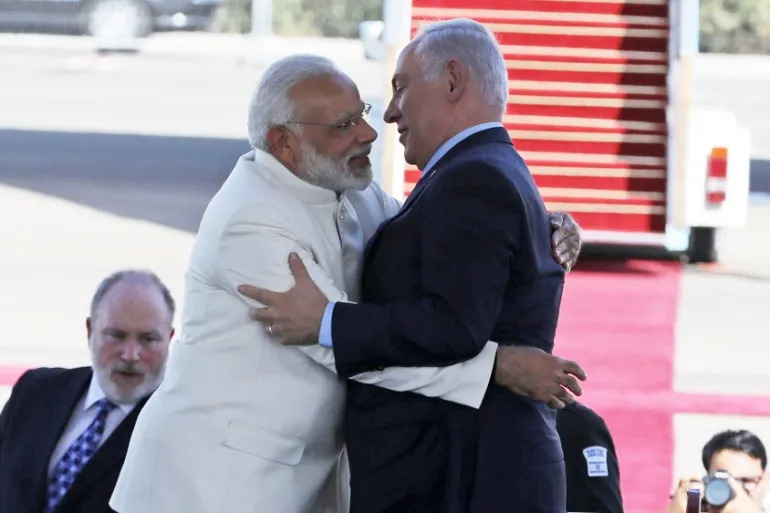
By When Narendra Modi landed in Tel Aviv in July 2017 and embraced Benjamin Netanyahu on the airport tarmac, it was more than diplomatic theatre. It marked a visible break from decades of calibrated distance that had defined India’s approach to Israel. For the first time, an Indian prime minister visited the country — and did so without pairing the trip with a stop in Ramallah, a long-standing balancing act maintained by his predecessors.
Nearly a decade later, as Modi prepares for another visit to Israel, that symbolic shift has hardened into policy. What was once a discreet security partnership conducted largely behind closed doors has evolved into one of New Delhi’s most openly acknowledged strategic relationships. In the process, India’s posture on Palestine — historically central to its foreign policy identity — has become more muted.
India recognised Israel in 1950 but delayed full diplomatic ties until 1992, wary of alienating Arab partners and mindful of its leadership role in the Non-Aligned Movement. For decades, Indian leaders publicly championed Palestinian statehood, even as defence cooperation with Israel quietly expanded after the Cold War.
Under Modi, that duality has narrowed. Defence and technology ties with Israel have accelerated, with India emerging as one of its largest arms buyers. Cooperation now spans drones, missile systems, cyber technology and agriculture innovation. A recently signed memorandum aims to deepen joint defence development, including discussions around missile defence systems.
Also Read – PM Narendra Modi to Visit Israel on February 25, Set to Address Knesset
The ideological chemistry between Modi’s Bharatiya Janata Party (BJP) and Israel’s right-wing leadership has also drawn attention. Both governments foreground national security and counterterrorism as defining pillars of state policy. Modi was among the first global leaders to condemn the October 7 attacks in Israel and express solidarity with the Israeli government.
Yet this strategic convergence comes at a diplomatic cost, critics argue. India, once a vocal advocate for Palestinian rights in multilateral forums, has adopted a more cautious tone during the Gaza war. While reiterating support for a two-state solution, New Delhi has largely avoided direct criticism of Israeli military actions, drawing scrutiny from sections of the Global South that once saw India as a moral counterweight to Western powers.
Trade figures illustrate the transformation. Bilateral commerce has grown from a few hundred million dollars in the early 1990s to over $6 billion today, dominated by diamonds, chemicals and defence equipment. Negotiations on a free trade agreement are ongoing, and people-to-people ties have expanded, including labour mobility agreements in recent years.
At the same time, India continues to maintain strong relations with Gulf states and Iran, walking a careful diplomatic tightrope. Officials describe this as “strategic autonomy” — engaging all sides without entanglement in regional rivalries. However, geopolitical shifts, including tensions involving Iran and evolving US policies, complicate that balancing act.
Modi’s Israel outreach has undeniably “broken down walls” that once constrained bilateral ties. Whether that recalibration enhances India’s global leverage or erodes its historic moral capital remains an open question — one that will likely shadow his upcoming visit.