 By
By
India has advised the family members of its officials posted in Bangladesh to return home as a precautionary measure, citing the evolving security situation in the neighbouring country ahead of its upcoming parliamentary elections. The move, taken weeks before Bangladesh goes to the polls, reflects New Delhi’s heightened vigilance as political uncertainty and public mobilisation increase in the run-up to a critical vote.
According to official sources, the advisory applies to dependents of Indian diplomats and staff serving at the Indian High Commission in Dhaka as well as other Indian posts across Bangladesh. While the decision does not amount to a scaling down of India’s diplomatic presence, it signals concern over potential disruptions linked to election-related tensions and law-and-order challenges.
“Given the prevailing security situation, and purely as a precaution, the dependents of Indian officials have been advised to return to India,” a source familiar with the matter said. The source emphasised that the Indian mission and all associated offices in Bangladesh remain fully operational and that diplomatic and consular work continues without interruption.
Also Read – BCCI Acts After Shah Rukh Khan Faces Backlash Over KKR Star Mustafizur Rahman
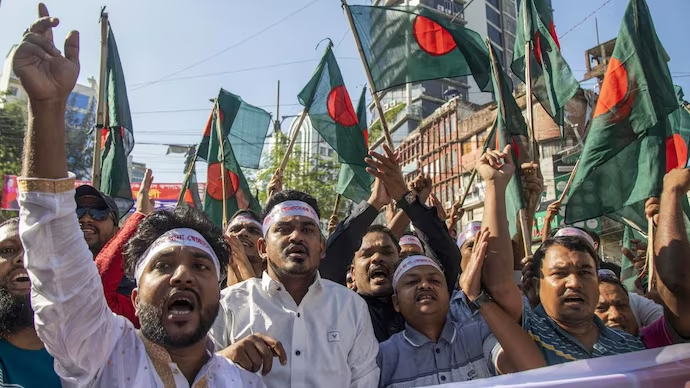
The advisory comes at a sensitive moment for Bangladesh, which is preparing for parliamentary elections scheduled for February 12. The polls are expected to be closely watched both domestically and internationally, following months of political churn after the ouster of former Prime Minister Sheikh Hasina. Street protests, rival political campaigns, and heightened political rhetoric have contributed to concerns about public order, particularly in urban centres.
Indian officials stressed that the step should not be interpreted as a downgrade in bilateral engagement. Instead, it is being framed as a standard safety measure, similar to actions taken by governments worldwide when electoral or political transitions raise the risk of unrest. “Our engagement with Bangladesh remains strong and uninterrupted,” another official said, adding that coordination with local authorities continues.
Bangladesh is currently being governed by an interim administration led by Nobel laureate Muhammad Yunus, which has promised institutional reforms and a reset of the country’s political framework. In recent weeks, Yunus has urged citizens to support a proposed reform package through a referendum that will be held alongside the general elections. Among the most consequential proposals is a cap on executive power, including a provision that would prevent any individual from serving as prime minister for more than 10 years.
The referendum, scheduled to take place on the same day as the general election, has added a new layer of political intensity to the campaign season. Supporters argue that the reforms are necessary to prevent the concentration of power and to strengthen democratic institutions. Critics, however, have questioned the timing of the vote and raised concerns about the political stability of the transition period.
Also Read – Mob lynching of minority Hindu man sparks row as interim government blames victim’s ‘terror’ activities
For India, developments in Bangladesh carry strategic, economic, and security implications. The two countries share a long and porous border, deep trade ties, and extensive people-to-people connections. Any prolonged instability in Bangladesh could have ripple effects, including disruptions to cross-border trade, migration pressures, and regional security concerns.
Security analysts note that election periods in South Asia often bring an uptick in political mobilisation, which can occasionally turn volatile. Advising families to temporarily relocate allows diplomatic staff to focus on their duties while reducing potential risks to dependents. “It’s a risk-management decision rather than a response to a specific incident,” a former diplomat explained.
Despite the advisory, Indian authorities have made it clear that there is no evacuation of personnel underway and no reduction in staffing levels. Consular services for Indian nationals in Bangladesh remain available, and officials continue to monitor the situation closely.
As Bangladesh heads into what is being described as a defining electoral moment, regional partners like India are likely to maintain a cautious but engaged approach. The coming weeks will be crucial in determining whether the polls and the accompanying referendum can be conducted peacefully, setting the stage for political stability in the country’s post-Hasina era.