 By
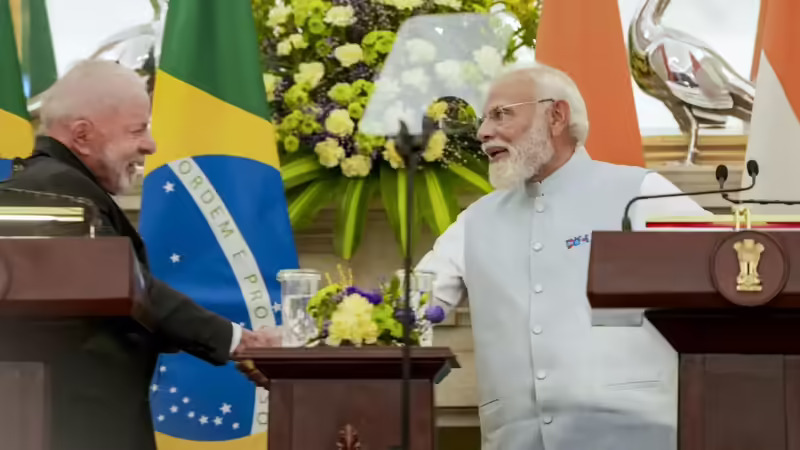
By India and Brazil have elevated their partnership from diplomatic warmth to strategic ambition, setting a target of $20 billion in bilateral trade within five years and signing key agreements in rare earths, digital infrastructure and mining supply chains. The announcements followed delegation-level talks in New Delhi between Prime Minister Narendra Modi and Brazilian President Luiz Inacio Lula da Silva, marking a decisive push to diversify economic ties amid global supply chain uncertainties.
Standing beside Lula after their meeting, Modi framed the trade target as more than a commercial benchmark. “Our trade is not just a number; it is a reflection of trust,” he said, underlining that Brazil is India’s largest trading partner in Latin America. Both leaders indicated that expanding the India–MERCOSUR preferential trade framework could provide further momentum to the goal.
Three agreements formed the centrepiece of the visit. The two sides signed memorandums of understanding on a digital partnership for the future, cooperation in rare earths and critical minerals, and collaboration in mining and steel supply chains. Officials described the rare earths pact as particularly significant at a time when countries are seeking to reduce dependence on limited suppliers for critical inputs used in electronics, electric vehicles and renewable energy technologies.
India, which has been aggressively courting partners to secure access to lithium, cobalt and rare earth elements, sees Brazil as a resource-rich ally with complementary capabilities. Brazil, in turn, is looking to attract investment and technological collaboration to scale up extraction and processing capacities.
The digital partnership agreement also signals a shift toward deeper technology integration. Modi said India is working toward establishing a Centre of Excellence for Digital Public Infrastructure in Brazil, drawing on India’s experience in building large-scale digital platforms. Cooperation in artificial intelligence, semiconductors, supercomputing and blockchain was identified as priority areas.
Energy transition emerged as another pillar of the dialogue. Both leaders agreed to expand cooperation not only in hydrocarbons but also in renewable energy, ethanol blending and sustainable aviation fuel. Brazil’s participation in the Global Biofuel Alliance was highlighted as evidence of shared climate commitments. India has been positioning itself as a bridge between developed and developing nations on green energy transitions, and Brazil’s strong biofuel ecosystem offers a natural convergence point.
President Lula described India as a “digital superpower” and portrayed the partnership as a meeting of two major democracies of the Global South. He emphasised the need for stronger strategic dialogue in what he called a turbulent global environment, pointing to the role both nations play in multilateral forums such as the G20, the United Nations and the World Trade Organization.
The visit included ceremonial engagements at Rashtrapati Bhavan and homage to Mahatma Gandhi at Rajghat, reinforcing symbolic ties alongside substantive agreements. Lula was accompanied by a sizeable delegation of ministers and business leaders, who are expected to participate in a bilateral business forum aimed at accelerating commercial partnerships.
The renewed momentum follows Modi’s visit to Brasília in July 2025 — the first by an Indian Prime Minister in over five decades — which laid the groundwork for closer cooperation. Analysts suggest the rare earths agreement could prove pivotal, particularly as global competition intensifies over access to critical minerals.
While the $20 billion trade target represents a significant leap from current levels, officials from both sides expressed confidence that diversified cooperation — spanning digital infrastructure, clean energy and strategic resources — will provide the necessary traction. For India and Brazil, the partnership is increasingly being defined not just by shared democratic values, but by a calculated alignment of economic and geopolitical interests.