 By
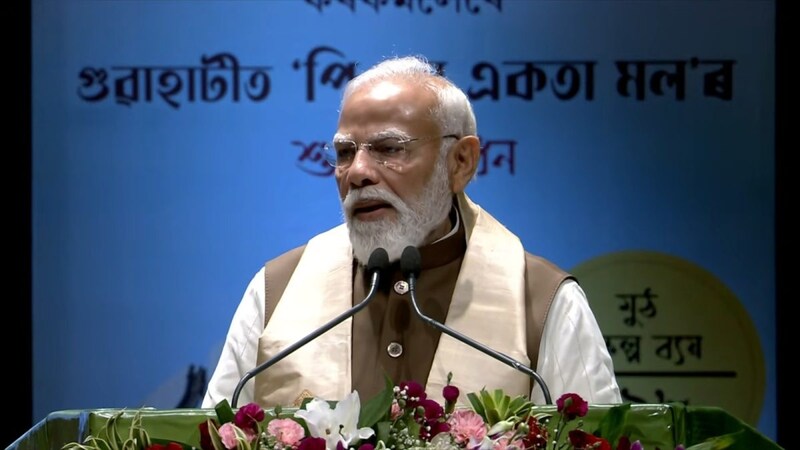
By Prime Minister Narendra Modi on Friday launched a sharp attack on the Congress party, accusing it of spreading misinformation at a time when global tensions are affecting energy markets and economic stability. Speaking at a public event in Guwahati after inaugurating several development projects, the Prime Minister said political parties should act responsibly during international crises instead of fuelling confusion among citizens.
Modi argued that while the government is focusing on maintaining economic stability and protecting the interests of farmers, the opposition has chosen to spread misleading narratives about the impact of the ongoing West Asia conflict. According to him, such claims risk creating unnecessary anxiety among people when the government is already working to manage the economic consequences of global instability.
In his speech, the Prime Minister referred to India’s first Prime Minister, Jawaharlal Nehru, urging Congress leaders to revisit one of Nehru’s early Independence Day addresses from the Red Fort. Modi said Nehru had once explained how wars taking place far away from India—such as the conflict on the Korean Peninsula—could still trigger inflation and economic pressures in the country.
By invoking that historical example, Modi suggested that global conflicts have always had ripple effects on India’s economy. However, he accused the Congress of ignoring that context and instead using the current geopolitical situation to spread what he called “misleading claims” about the government’s handling of the crisis.
The Prime Minister also used the occasion to highlight the government’s policies aimed at strengthening India’s agricultural sector. He said the ruling alliance had worked to ensure that farmers remained protected even during major global disruptions such as the COVID-19 pandemic and subsequent international conflicts that affected supply chains.
According to Modi, programmes like the Pradhan Mantri Kisan Samman Nidhi have provided direct financial assistance to millions of farmers across the country. He criticised what he described as rumours circulated by opposition leaders suggesting that beneficiaries would be required to return these funds after elections, calling such claims baseless.
The Prime Minister also pointed to long-term reforms introduced by his government to reduce agriculture’s vulnerability to global shocks. He said policies focused on irrigation efficiency, such as the “Per Drop, More Crop” initiative, have encouraged farmers to adopt modern techniques like drip and sprinkler irrigation. These technologies, he argued, help improve productivity while conserving water resources.
Modi further accused previous governments of leaving the agricultural sector overly dependent on imports, particularly fertilisers and other key inputs. Such dependence, he said, often led to rising cultivation costs whenever global supply chains were disrupted by geopolitical tensions or trade imbalances.
By contrast, he said the current government has been working to reduce those vulnerabilities through domestic production initiatives and policy reforms designed to strengthen rural economies.
The remarks come at a time when political debate has intensified over the economic impact of international conflicts, with both the government and opposition seeking to shape the narrative around inflation, energy prices and the broader state of the economy.