 By
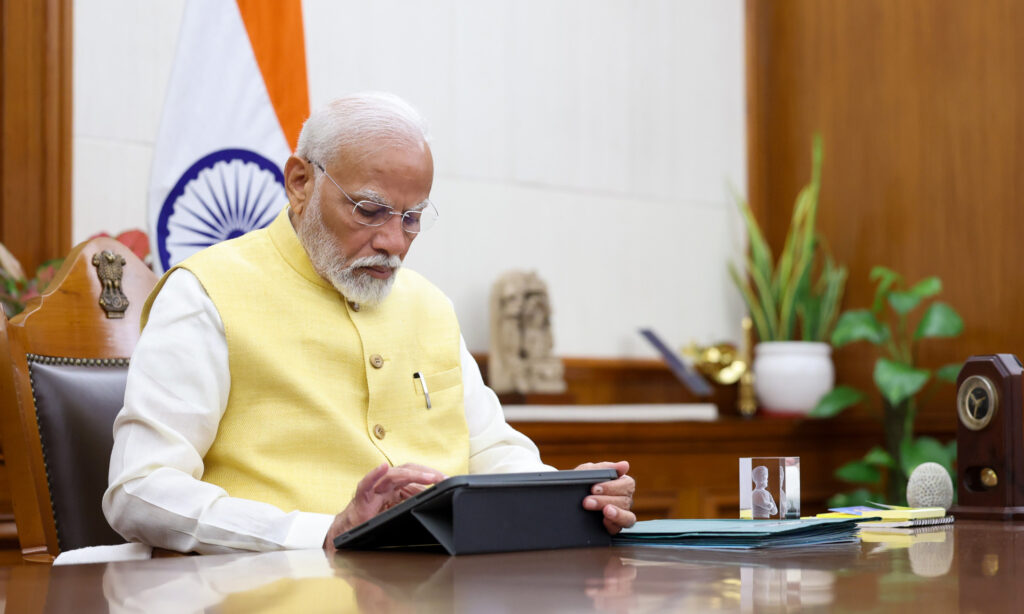
By For over five decades, the Prime Minister’s Office operated from the imposing sandstone corridors of South Block, the British-era structure that symbolised the nerve centre of India’s governance. On Friday, that chapter formally closes. Prime Minister Narendra Modi will shift his office to a newly constructed complex named Seva Teerth, signalling not just a change of address but a significant transformation in how the country’s administrative core is organised.
The move marks one of the most consequential institutional transitions since Independence. Before relocating, the Prime Minister is scheduled to chair the final Cabinet meeting at South Block — a venue that has witnessed historic decisions shaping India’s political, economic and strategic trajectory. Following the meeting, Union ministers and senior bureaucrats are expected to proceed to Seva Teerth, located less than a kilometre away within the new executive enclave.
The newly built Seva Teerth complex will house the Prime Minister’s Office, the Cabinet Secretariat, the office of the National Security Adviser (NSA), and India House — a dedicated venue designed to host high-level international delegations. Officials describe the facility as a modern administrative hub intended to streamline coordination among key arms of government that were previously spread across multiple buildings.
The Cabinet Secretariat has already moved from Rashtrapati Bhavan to Seva Teerth-2, while the NSA’s office is in the process of shifting from Sardar Patel Bhawan to Seva Teerth-3. The transition reflects a broader consolidation plan under the Centre’s redevelopment project aimed at modernising government infrastructure along Kartavya Path.
South Block and North Block, constructed in 1931 during British rule, have long stood as architectural symbols of state authority. The PMO itself traces its origins to 1947, when a modest Prime Minister’s Secretariat was created to assist the head of government with basic administrative functions. Over time, the office evolved into one of the most influential institutions in the country.
A significant restructuring occurred in 1964 when Lal Bahadur Shastri assumed office and the Secretariat received statutory backing under the Allocation of Business Rules. Its authority expanded further during Indira Gandhi’s tenure, reflecting the growing centralisation of executive power. In 1977, under Prime Minister Morarji Desai, the institution was officially renamed the Prime Minister’s Office — a designation that has since become synonymous with executive authority in India.
The relocation of the PMO is part of a larger administrative reshuffle that will see the ministries of defence and external affairs also vacate South Block in the coming weeks. Meanwhile, North Block — once home to key economic ministries — has already been fully vacated, with departments shifting to newly built offices along Kartavya Path.
With these moves, India’s traditional power centre at Raisina Hill is gradually giving way to a reimagined executive landscape. While the historic sandstone buildings will continue to stand as architectural landmarks, the daily mechanics of governance are now transitioning into a purpose-built, technology-enabled complex designed for contemporary administrative demands.
As the Prime Minister conducts his final official business from South Block, the shift to Seva Teerth represents both continuity and change — an evolution of India’s administrative architecture while retaining the institutional legacy built within those historic walls.