
 By
By Union Home Minister Amit Shah on Saturday projected confidence in the political future of the BJP-led National Democratic Alliance (NDA), asserting that Prime Minister Narendra Modi’s 12 years in office represent only the beginning of a much longer period of governance under the current leadership.
Addressing public gatherings in Maharashtra’s Kolhapur district, Shah described the Modi government’s tenure as a transformative phase in independent India’s history. He argued that the changes witnessed over the past decade have reshaped the country’s development trajectory, strengthened national security, and elevated India’s standing on the global stage.
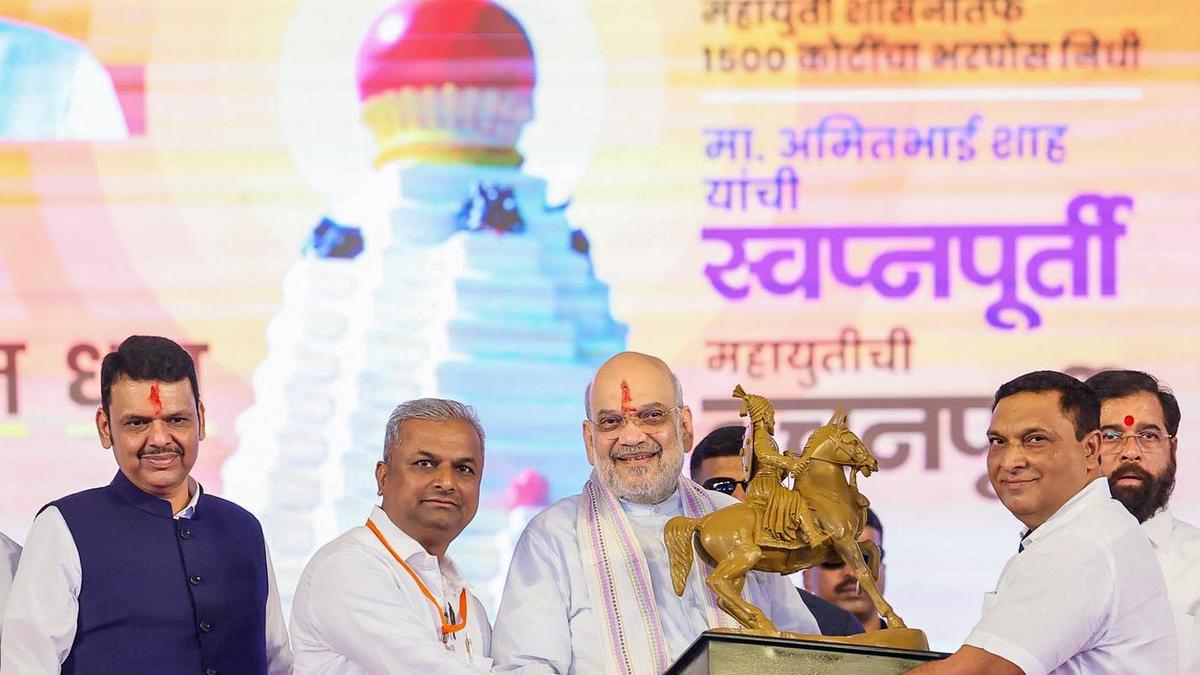
Speaking after the launch of the Ambabai Temple Corridor project, Shah said future generations would remember the current period as one marked by national resurgence and renewed confidence. According to him, Prime Minister Modi’s leadership has delivered outcomes that many once considered politically or administratively impossible.
Highlighting major religious and cultural projects undertaken during the last decade, Shah pointed to the construction of the Ram Temple in Ayodhya, the redevelopment of the Kashi Vishwanath Corridor, and restoration efforts at Kedarnath, Badrinath, Somnath, and Kamakhya. He said these initiatives reflected the government’s approach of balancing development with the preservation of India’s cultural heritage.
The Home Minister described the ₹500-crore Ambabai Temple Corridor project as another step in that direction. The redevelopment plan includes heritage conservation, modern visitor facilities, advanced security systems, galleries showcasing local history, and improved infrastructure aimed at enhancing the pilgrimage experience. He also announced that dozens of temples around the historic Mahalaxmi Temple complex would be preserved in consultation with heritage experts.
Beyond cultural initiatives, Shah credited the Modi government with accelerating growth in infrastructure, manufacturing, technology, semiconductor production, space exploration, and emerging sectors such as quantum engineering. He said India’s development model today combines economic progress with cultural confidence.
On national security, Shah contrasted the current government’s approach with previous administrations. He said India has adopted a more assertive response to security threats in recent years and highlighted efforts to modernise the armed forces. He also claimed that significant progress had been made in tackling terrorism in Jammu and Kashmir, reducing insurgency in the Northeast, and weakening Left-wing extremism.
The Home Minister further highlighted welfare schemes aimed at farmers, citing direct financial transfers under central government programmes and tax relief measures for the agricultural sector. He also announced a proposed cooperative initiative in Maharashtra that would help sugar factories lacking ethanol production facilities process their output more efficiently.
Turning to politics, Shah expressed confidence about the BJP’s prospects in upcoming elections and reiterated the party’s commitment to issues related to border security and illegal infiltration. He also took aim at opposition parties, accusing them of prioritising vote-bank politics over national interests.
Shah was in Kolhapur to lay the foundation stone for the new Pradakshina Marg and conservation works associated with the historic Mahalaxmi Temple complex.