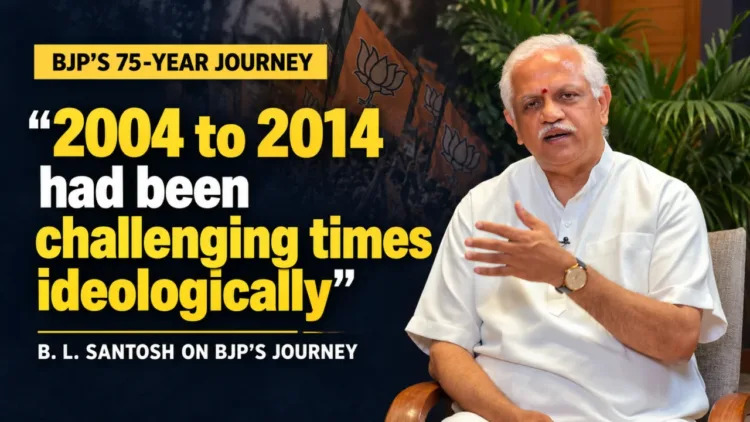
 By
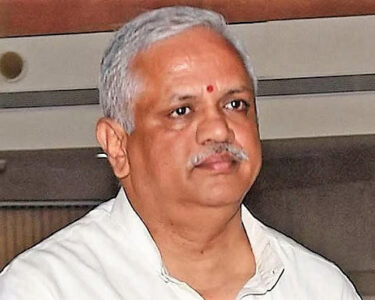
Santhosh argued that the challenges of those years extended beyond electoral setbacks. He pointed to the National Advisory Council (NAC), scrutiny of BJP leaders and debates over the portrayal of the Gujarat riots as examples of what he considered a broader political and ideological contest. His remarks offer the party organisation’s perspective on the years between the end of the Atal Bihari Vajpayee-led government and Narendra Modi’s arrival as prime minister.
Santhosh Says Challenges Went Beyond Electoral Politics
Reflecting on the decade, Santhosh said the period from 2004 to 2014 tested the BJP’s wider ideological movement, not just its electoral strength.
He cited the use of the term “saffron terror” and the establishment of the National Advisory Council during the Congress-led United Progressive Alliance (UPA) government as developments that, in his view, shaped the political environment of the time.
Santhosh questioned the role and authority of the NAC, arguing that it represented an additional centre of influence beyond the Prime Minister’s Office. He alleged that certain political and institutional developments during the period reflected the interests of groups whose priorities, in his assessment, were not aligned with national interests.
These remarks formed part of his broader argument that the BJP and its ideological associates faced challenges on several fronts during the decade.
Allegations of an Attempt to Sideline the BJP
Santhosh also alleged that the BJP faced sustained efforts to restrict its political influence after the Congress returned to power in 2004. Referring to the Congress’s return to office, he said the party had been determined to weaken the BJP’s position.
He cited the scrutiny faced by BJP leaders, including Narendra Modi, who was then chief minister of Gujarat, as part of what he described as a wider pattern of political targeting.
“This targeting was not one-off incident,” Santhosh said, arguing that the pressure extended beyond individual leaders to the BJP’s senior leadership and the Rashtriya Swayamsevak Sangh (RSS).
He characterised the alleged objective as an attempt to “purge” the BJP from the political landscape. These were Santhosh’s interpretations of the period, expressed during the interview, rather than independently established conclusions about the motives of the Congress or other political groups.
Universities and the ‘Saffron Terror’ Debate
The BJP leader also raised questions about the ideological influence of Left-leaning groups in universities and other institutions during the UPA years. He alleged that Left ideology had gained a strong presence in these spaces and suggested that its influence would become clearer over time.
Santhosh connected this issue with the public debate surrounding the Gujarat riots and the use of the phrase “saffron terror”. In his account, these debates were part of a wider struggle over how political events were interpreted and how the BJP and its ideological positions were represented.
His comments reflect the party’s criticism of the political and media environment of that period, particularly concerning issues of nationalism, religion and the treatment of its leadership.
How the BJP Regained Momentum After 2009
Despite describing the years from 2004 to 2009 as a relatively subdued period for the party, Santhosh said the BJP gradually regained its political rhythm after 2009.
He highlighted two broad strategies: bringing the governance records of BJP-ruled states to a national audience and challenging the Congress-led UPA on both political and ideological grounds.
According to Santhosh, these efforts helped the party strengthen its position ahead of the 2014 general election. He said the BJP’s return to power was widely anticipated by that stage, although the scale of its victory surprised many political observers.
The BJP won 282 seats in the 2014 Lok Sabha election, securing a majority on its own and bringing the Congress-led UPA’s decade in government to an end.
The 2014 Election as a Turning Point
Santhosh presented the BJP’s 2014 victory as the outcome of a longer period of organisational work and ideological contest, rather than simply a change in electoral fortunes. In his account, the years after 2009 were crucial in helping the party communicate its governance record, challenge its political opponents and rebuild public support.
His reflections underline how the BJP’s organisational leadership interprets the decade leading up to 2014: as a period marked by political difficulties, ideological disagreements and efforts to expand the party’s reach.
The interview provides an account of that history from within the BJP. Santhosh’s allegations about political motives and institutional pressures remain his assessment of the period, while the party’s electoral performance in 2014 marked a clear turning point in India’s national politics.