
 By
The Prime Minister also warned that cyber fraud, online scams and other forms of cross-border crime were emerging as serious challenges alongside terrorism and geopolitical conflicts. He called for greater regional cooperation to protect both maritime routes and the digital space, while proposing an East Asia Summit Cyber Crime Conference at India’s National Forensic Sciences University.
Maritime Security and Seafarers’ Protection Take Centre Stage
Highlighting the importance of international waterways to regional prosperity, Modi said ships and seafarers were facing growing risks. Conflicts have placed additional pressure on global supplies of food, fuel and fertilisers, while commercial vessels have also come under attack in sensitive maritime regions.
The safety of Indian seafarers has become a particular concern amid the ongoing conflicts in the Strait of Hormuz and the Black Sea. The source report noted that at least 22 Indian nationals had been killed since the US-Israel and Iran war began in February.
Under the proposed initiative, EAS members will work together on joint training and emergency response arrangements. Modi also called for a broader, long-term ASEAN-India maritime cooperation plan covering connectivity, scientific research, disaster management, Coast Guard cooperation, maritime domain awareness and seafarers’ security.
India Proposes Regional Action Against Cybercrime
The Prime Minister said digital threats, including online scams and cyber fraud, were increasing across borders and required a coordinated response. He proposed hosting an East Asia Summit Cyber Crime Conference at the National Forensic Sciences University in India to strengthen regional capabilities and cooperation in cybercrime investigations.
Modi also referred to India’s AI Impact Summit, where the country had stressed the importance of developing artificial intelligence that is human-centric, inclusive and safe. He highlighted digital watermarking as one of the tools that could help tackle deepfakes and misinformation.
EAS leaders also adopted a joint statement on combating online scams, reflecting a shared concern over the growing risks posed by digital crime.
Modi Calls for Peace and a Rules-Based Indo-Pacific
At the Manila meeting, Modi said the world needed peace, stability and predictability as conflicts continued to disrupt international supply chains and create uncertainty. He described the East Asia Summit as an important platform for dialogue and cooperation on shared regional and global challenges.
He reiterated India’s support for a free, open, inclusive and rules-based Indo-Pacific, adding that ASEAN unity and centrality remained central to India’s Act East Policy. Referring to conflicts in Ukraine and West Asia, he said India would continue to support efforts aimed at achieving peace.
Cultural and Educational Ties to Get a Further Push
Modi also proposed initiatives to highlight India’s historical and cultural connections with East Asia. He said the National Maritime Heritage Complex being developed at Lothal in Gujarat would showcase the region’s shared maritime heritage.
India will also host an East Asia Summit Maritime Heritage Festival at Lothal. In addition, the country plans to organise the East Asia Summit University Heads Conclave at Nalanda next year to encourage cooperation in education and research.
These proposals are intended to build on the long-standing cultural links between India and countries in the region.
New Initiatives to Expand India-ASEAN Cooperation
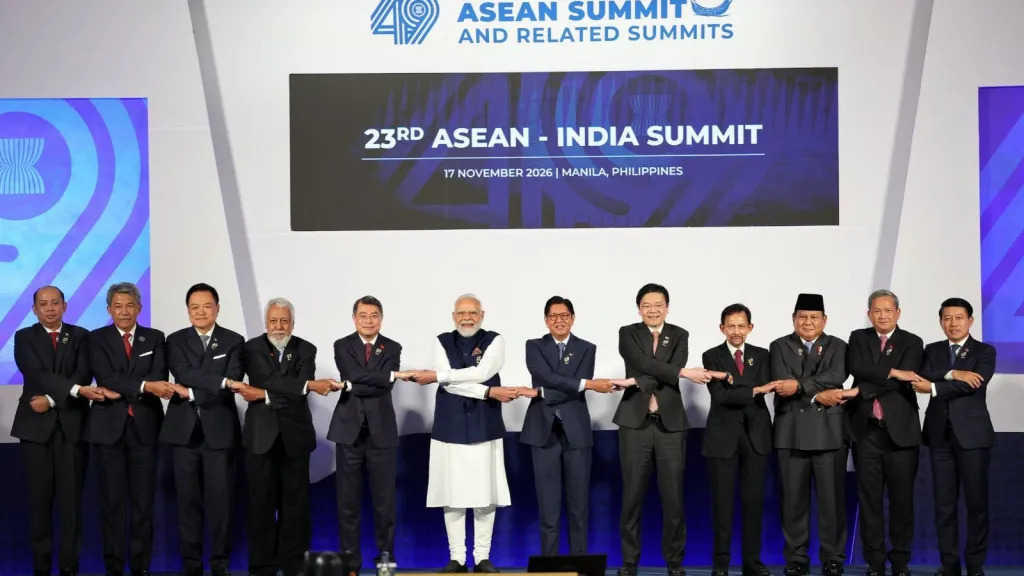
Earlier on Tuesday, during the 23rd ASEAN-India Summit, Modi outlined a wider set of proposals to deepen economic, technological and people-to-people ties.
Among the key announcements and proposals were free e-visas for tourists from ASEAN countries, a joint cyber forensics training programme, technical exchanges in nuclear energy, a space hackathon and cooperation in mining and critical minerals.
He also called for stronger youth engagement through youth summits, exchanges involving young parliamentarians and start-up hackathons. Expanding scholarship opportunities for students from ASEAN countries at Nalanda University was another proposal.
The Prime Minister said India’s Act East Policy had given fresh momentum to relations with ASEAN over the past 12 years, taking the partnership beyond traditional cultural ties into areas such as digital technology, defence and space.
India and ASEAN Look Towards Shared Goals
Modi said the ASEAN Community Vision 2045 and India’s Viksit Bharat 2047 vision could provide a framework for advancing shared regional aspirations. He expressed confidence that the India-ASEAN Comprehensive Strategic Partnership would grow further and contribute to a secure, inclusive and prosperous Indo-Pacific.
He noted that India and ASEAN together account for nearly a quarter of the world’s population, making cooperation essential to the region’s future.
Since 2014, India has undertaken more than 100 initiatives to strengthen people-to-people connections with ASEAN countries, launched nearly 250 quick-impact projects and provided over 10,000 skill-development scholarships, Modi said. Direct air connectivity with nine ASEAN nations and increasing tourism have further strengthened these links.
The leaders also adopted a joint statement on India-ASEAN cooperation in disaster management, adding another area to the expanding partnership.