
 By
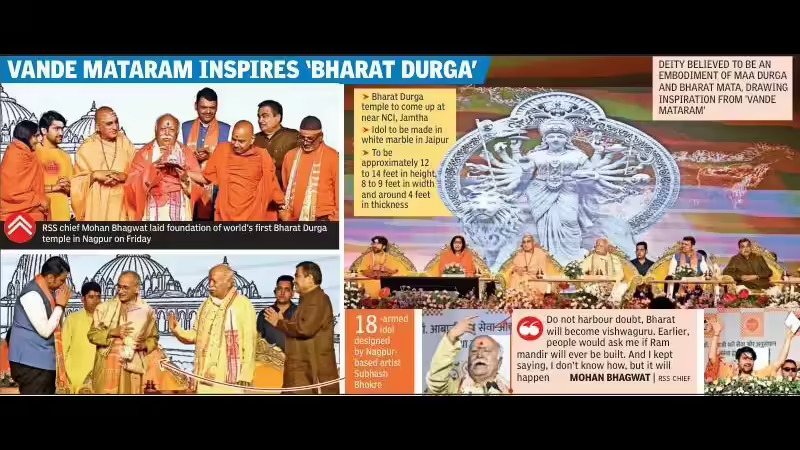
By Mohan Bhagwat on Friday struck a note of quiet confidence about India’s future, suggesting that the country’s emergence as a global leader is not a question of “if” but “when.” Speaking in Nagpur, he drew a parallel with the long-awaited construction of the Ram Mandir Ayodhya, saying that just as that became a reality over time, India’s journey towards becoming a “Vishwaguru” will also unfold naturally.
The remarks came during a foundation-laying ceremony for what organisers described as a unique “Bharat Durga” temple—an initiative blending spiritual symbolism with national identity. The proposed temple, inspired by the idea of Bharat Mata and Maa Durga, is being envisioned as more than a place of worship; rather, as a representation of cultural unity and collective consciousness.
Bhagwat’s speech went beyond religious themes and touched upon India’s place in a rapidly changing world. He argued that global uncertainties and conflicts highlight the need for a value system rooted in balance and coexistence—principles he associated with Indian civilisation. According to him, the world is searching for direction, and India is positioned to offer that path through its philosophical traditions.
At the same time, he called for introspection within the country. Bhagwat pointed out that the legacy of colonial rule continues to influence thinking patterns, urging people to reconnect with indigenous knowledge systems and cultural foundations. In his view, reclaiming this intellectual and cultural confidence is essential for India to fully realise its potential on the global stage.
A key theme of his address was the idea that national progress cannot rely solely on institutions or leadership—it must be reflected in the conduct of citizens. Using traditional philosophical references, Bhagwat emphasised that true devotion or national pride comes from internal transformation, not just external rituals or symbols.
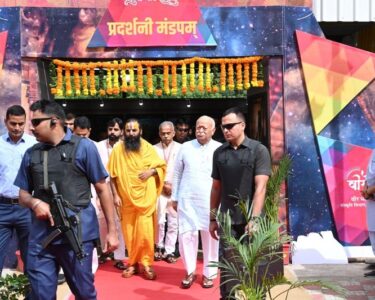
The event also brought together several prominent religious and public figures, including Devendra Fadnavis and Nitin Gadkari, along with spiritual leaders from across traditions. Their presence underscored the broader attempt to position the initiative as a convergence of cultural, spiritual, and social thought.
Speakers at the gathering echoed similar sentiments, highlighting India’s enduring civilisational identity and its resilience through centuries of change. The proposed temple, with a large marble idol planned to be crafted in Jaipur, is being presented as a symbol of that continuity.
While the concept of India as a “Vishwaguru” often sparks debate, Bhagwat’s message focused less on timelines and more on belief. His argument was simple: sustained conviction, combined with cultural awareness and collective effort, will eventually shape India’s global role.