

 By
The figures highlight two distinct aspects of the government’s approach: action against assets associated with organised crime and the conversion of certain recovered plots into affordable homes. However, the value of properties attached or seized should not be confused with land permanently confiscated by the government, and the number of completed homes remains much smaller than the overall value of reported enforcement action. A proposed 1,200-home project in Prayagraj is expected to expand the housing component once construction is completed.
Property Action Under the Gangsters Act Crosses ₹15,000 Crore
The Uttar Pradesh government has reported a steady rise in the cumulative value of property-related action since Yogi Adityanath became chief minister in March 2017.
The reported figures rose from ₹1,800 crore in August 2021 to ₹9,022.33 crore in March 2023. The total reached ₹11,841 crore by August 2023 and ₹14,246 crore by the end of 2024, before climbing to ₹15,233 crore by October 2026.
These figures cover different types of enforcement measures, including property attachment, demolition of illegal structures and final confiscation following legal proceedings. The distinctions matter: attachment places property under legal control while proceedings continue, demolition removes a structure, and final confiscation can permanently transfer ownership to the government under the applicable legal process.
The cumulative figure therefore reflects the reported scale of enforcement activity, rather than the value of assets that have all been permanently confiscated.
Prayagraj and Lucknow: 148 Flats Delivered to Families
Two completed housing projects illustrate how the government has used selected plots linked to alleged criminal networks to provide homes for economically weaker sections.
76 Flats in Prayagraj
In Lukarganj, Prayagraj, the Prayagraj Development Authority constructed 76 flats under the Pradhan Mantri Awas Yojana-Urban on land recovered from the network of late gangster-politician Atiq Ahmed.
The project cost approximately ₹6.6 crore, and the keys were handed over to beneficiaries on June 30, 2023. The development became one of the most visible examples of the state’s stated approach of putting recovered land to public use.
72 EWS Flats in Lucknow
In Lucknow’s Dalibagh area, the Lucknow Development Authority built 72 economically weaker section (EWS) flats on a plot of around 2,322 square metres linked to Mukhtar Ansari and his family.
Allotment letters were distributed on November 5, 2025. Each flat measures 36.65 square metres and is priced at ₹10.70 lakh.
The property’s history also involves allegations concerning structures built illegally on evacuee property, bringing a separate legal framework into the picture. The LDA’s housing project has nevertheless moved ahead.
Together, the two developments account for 148 completed flats on identified plots linked to criminal networks.
Prayagraj Project Could Add Another 1,200 Homes
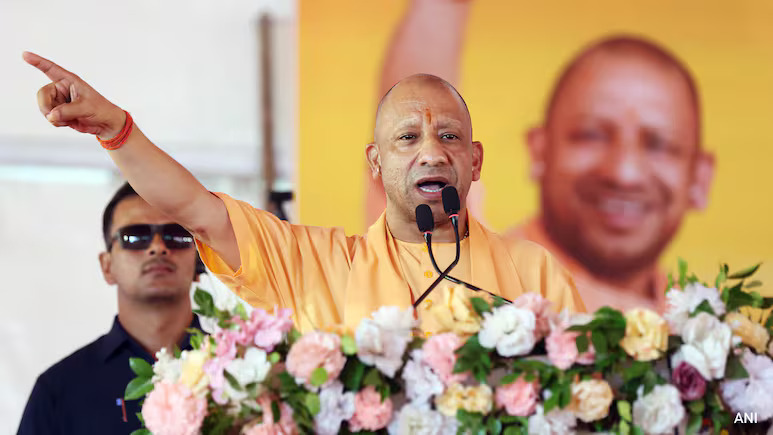
The next major housing project is planned at Kasari-Masari in Prayagraj. On October 15, 2026, Adityanath laid the foundation stone for a proposed 1,200-home development under the Padmalok Awas Yojana on land reclaimed from the Atiq Ahmed network.
The project is planned in two phases, with 602 homes in the first phase and 598 in the second.
If all 1,200 homes are completed and delivered as planned, the total number of homes built on gangster-linked land across the three projects would rise from 148 to 1,348. That figure remains a future target, however, rather than a completed housing count.
A separate handover of 160 EWS flats at the Palm Paradise complex in Gorakhpur in October 2025 formed part of the state’s wider affordable housing programme and is distinct from the two completed projects on the identified gangster-linked plots.
Why the Number of Homes Is Still Limited
The gap between the reported value of property action and the number of homes delivered reflects the different stages involved in enforcement and redevelopment.
Properties may remain attached for years while court cases continue. Some recovered plots are used for roads, parks, police facilities or other public infrastructure rather than housing. Construction also requires planning, approvals, funding and time, while permanent confiscation depends on the outcome of legal proceedings.
A consolidated public record separating attached assets, final confiscations, demolitions, court-ordered releases and housing projects with confirmed possession status would help establish how much recovered property has ultimately been put to public use.
The distinction is important when assessing the overall results of the policy. A high value of assets covered by enforcement action does not automatically translate into an equivalent amount of permanently acquired government property or completed housing.
From Enforcement to Public Use
For residents in areas such as Krishnapuri in Meerut, where demolition drives have become a recurring feature of anti-encroachment and enforcement action, the government’s approach is increasingly visible on the ground. Its stated objective is to move beyond action against illegal structures and use selected reclaimed land for public benefit.
The completed flats in Prayagraj and Lucknow provide concrete examples of that approach, while the Kasari-Masari project will be an important next test of its scale.
The key measure going forward will be not only how much property is attached or confiscated, but also how much land is legally secured, developed and ultimately handed over for public use. For the proposed Prayagraj project, completion and possession of the 1,200 homes will determine whether the government’s housing initiative expands as planned.