
 By
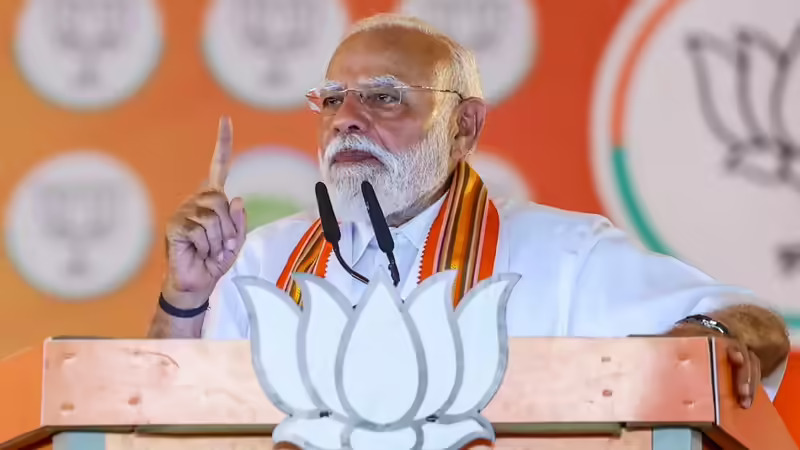
By Prime Minister Narendra Modi on Sunday ramped up his campaign in West Bengal, taking a direct swipe at the ruling All India Trinamool Congress and urging women voters to hold the party accountable in the upcoming Assembly elections. Addressing multiple rallies across the state, Modi framed the election as a turning point, particularly for women, whom he said would play a decisive role in shaping the outcome.
Speaking at back-to-back rallies in Bankura, Purulia, Jhargram and Midnapore, the Prime Minister accused the TMC of failing to support measures aimed at increasing women’s representation in legislatures. He alleged that political opposition to the women’s reservation proposal had denied women greater participation in decision-making, and called on voters to respond through the ballot.
Modi repeatedly positioned women’s welfare as a central plank of his campaign, arguing that stronger representation would lead to greater accountability in governance. He claimed that political parties resisting such reforms feared scrutiny from women leaders emerging from grassroots backgrounds.
The Prime Minister also outlined a series of welfare promises aimed at women and families. These included financial assistance for pregnant women, additional support after childbirth, free vaccination for cervical cancer, and access to low-cost medicines through government-run outlets. He also spoke about broader healthcare measures, including free treatment up to ₹5 lakh and dialysis services in public hospitals.
During the hectic campaign schedule, Modi made a brief stop at a roadside stall in Jhargram, interacting with locals—a moment that quickly gained traction on social media as part of the BJP’s outreach efforts to connect with voters at the ground level.
Beyond welfare, Modi sharpened his criticism of the state government on issues such as alleged corruption, infiltration, and governance. He claimed that West Bengal’s identity and development were at risk, accusing the ruling party of prioritising political interests over public welfare. He also raised concerns about reservation policies, alleging that certain decisions were being made in ways that could conflict with constitutional provisions.
The Prime Minister further targeted the TMC’s record in tribal regions, arguing that development had lagged in these areas. He contrasted this with the BJP’s outreach to tribal communities, highlighting the election of India’s first tribal woman President as an example of representation at the national level.
With polling set to take place in phases beginning April 23, the campaign in West Bengal has entered a high-pitch phase. Modi’s remarks reflect the BJP’s strategy of combining welfare promises with sharp political attacks, particularly aimed at consolidating women voters—a demographic seen as increasingly influential in determining electoral outcomes.