 By
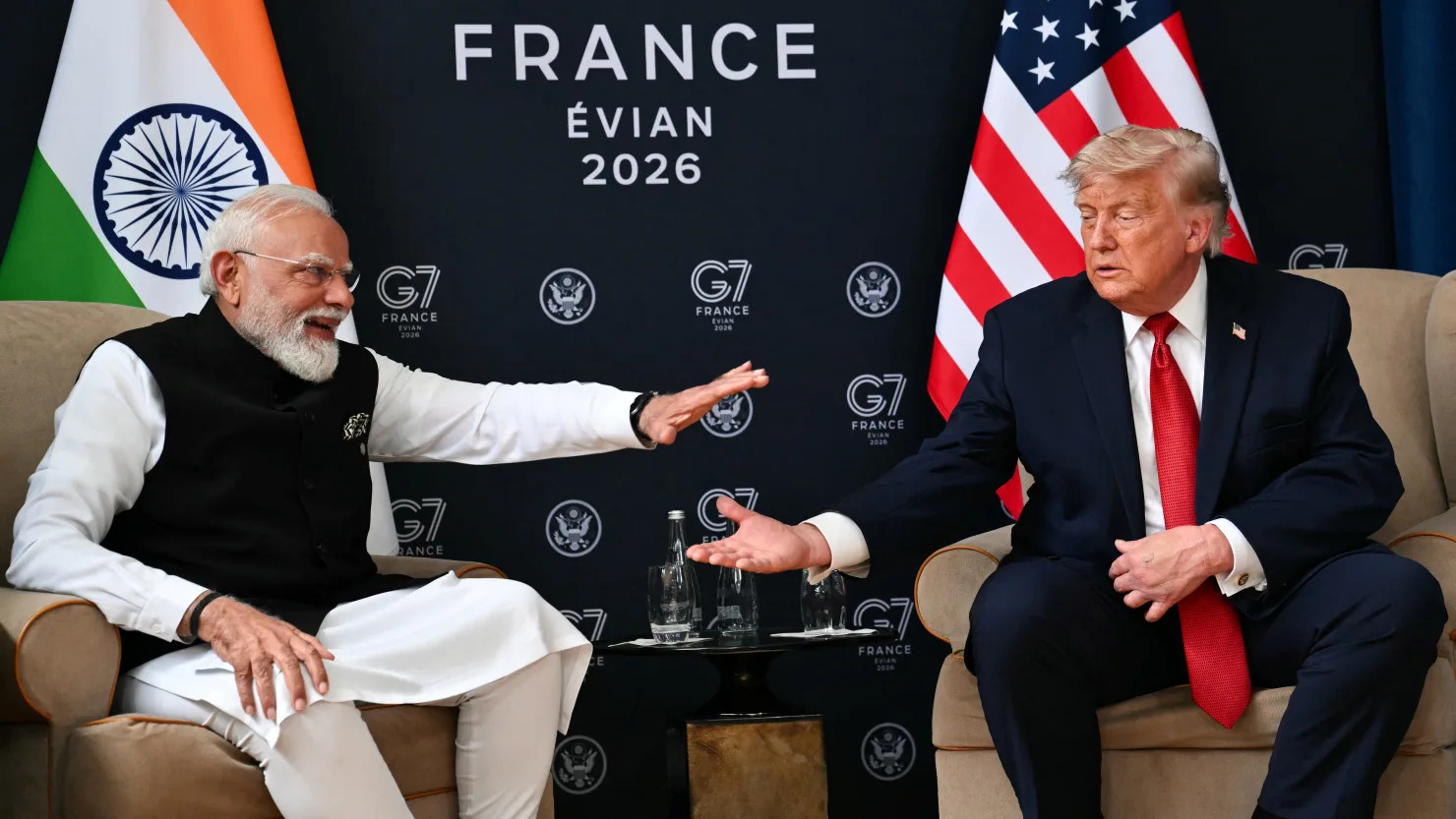
By The personal rapport between Prime Minister Narendra Modi and US President Donald Trump was once again on display at the G7 Summit, where the two leaders shared warm exchanges and reaffirmed the importance of India-US relations. Yet behind the friendly optics, a number of unresolved issues continue to test the strength of one of the world’s most consequential strategic partnerships.
Speaking to reporters on the sidelines of the summit, Trump praised Modi’s leadership and underscored his confidence in India under the Prime Minister’s stewardship. His remarks highlighted a relationship that has often been defined by personal chemistry, direct communication, and mutual political respect. For observers, the meeting served as a reminder that despite policy disagreements, the leaders remain comfortable engaging with each other on critical global issues.
Trump’s comments came as India seeks a larger role in international affairs, particularly in regions facing geopolitical uncertainty. While acknowledging India’s growing influence, the US President suggested that New Delhi remains an important partner in shaping global outcomes, especially under Modi’s leadership.
However, the warmth between the two leaders contrasts with growing complexities in the broader bilateral relationship. Trade negotiations between India and the United States remain unfinished months after both sides expressed optimism about reaching a comprehensive agreement. Businesses in both countries continue to watch closely as discussions move forward amid concerns over tariffs and market access.
Strategic analysts also point to changing geopolitical calculations in Washington. Recent signals from the US administration, including a stronger focus on direct engagement with China, have sparked debate about India’s evolving place in American foreign policy. While India remains a key partner in the Indo-Pacific, some experts believe Washington is recalibrating its priorities in response to changing global realities.
Security concerns also surfaced during the summit. Prime Minister Modi reportedly raised the issue of Indian sailors who lost their lives during recent tensions in the Gulf region, emphasizing the need to protect Indian citizens working in international waters. The matter has generated public concern in India and added another layer to ongoing diplomatic discussions.
Immigration remains another sensitive topic. Proposed changes affecting work visas have attracted attention because Indian professionals account for a significant share of highly skilled workers employed in the United States. Despite concerns, Trump acknowledged the contribution of Indian talent to the American economy and expressed confidence in the long-standing people-to-people relationship between the two nations.
The G7 interaction ultimately reflected the dual reality of India-US ties today. On one hand, Modi and Trump continue to maintain a strong personal connection that helps keep communication channels open. On the other, trade disputes, immigration policies, and shifting geopolitical priorities suggest that managing the partnership will require careful diplomacy in the years ahead.
As both countries navigate a rapidly changing global landscape, the challenge will be converting personal goodwill into long-term strategic and economic gains.