
 By
By Is economic growth alone enough to define progress, or should quality of life take centre stage? That question took the spotlight in Chandigarh on Sunday, where BL Santhosh urged a broader rethink of what development should mean for India.
Speaking at a lecture on the Bharatiya Janata Party’s ideological foundation of “Integral Humanism,” Santhosh argued that the country—and society at large—needs to reassess its priorities. Instead of focusing solely on boosting Gross Domestic Product (GDP), he suggested that equal, if not greater, attention must be given to improving everyday livability.
Santhosh pointed out what he sees as a contradiction in modern development models. “We keep investing in more courts, police stations, and hospitals,” he said, “but rarely ask how to build a society where the need for these institutions is reduced.” According to him, such a shift might not immediately reflect in GDP figures, but it could lead to a healthier and more balanced society in the long run.
He acknowledged that India has made strides in areas like healthcare, education, and infrastructure. Yet, he noted, persistent issues such as crime and disease continue to challenge the idea that growth alone can solve systemic problems. His remarks framed development as not just an economic exercise, but a social and cultural one as well.
Drawing on the philosophy of Deendayal Upadhyaya, Santhosh revisited the concept of Integral Humanism, which emphasises a holistic approach to progress—balancing material growth with social harmony and ethical values. He also placed this idea in a global context, referencing historical milestones such as the American Revolution and the French Revolution, along with the influence of Marxist thought and Charles Darwin’s theory of evolution. These, he said, have shaped modern economic and social systems, often prioritising material gain.
Contrasting Western notions of profit with the Indian idea of “Shubh Laabh” (auspicious gain), Santhosh argued that unchecked consumerism and capitalism can create imbalances in society. He expressed concern that rapid urbanisation and a consumption-driven lifestyle are encouraging individualism at the cost of collective thinking.
“We are increasingly seeing ourselves as isolated individuals rather than part of a larger national fabric,” he said, adding that this shift could weaken social cohesion over time.
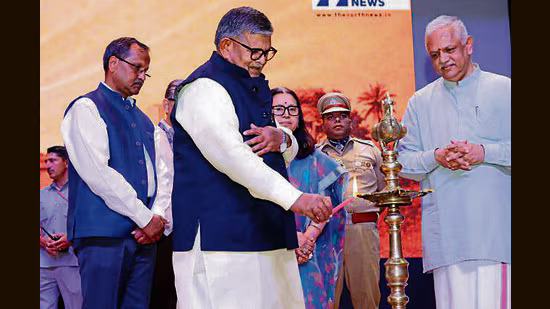
The event was attended by several prominent figures, including Gulab Chand Kataria, Renu Vig, and author Dharinder Tayal. Discussions at the gathering revolved around finding a balance between economic ambition and societal well-being.
Santhosh concluded by calling for a development model that goes beyond numbers—one that prioritises human values, community well-being, and sustainable progress alongside economic growth.