
 By
By India and Japan on Thursday expanded their strategic partnership by signing a series of key agreements covering artificial intelligence, critical minerals, energy security and defence cooperation, marking another step forward in the two countries’ growing economic and geopolitical collaboration.
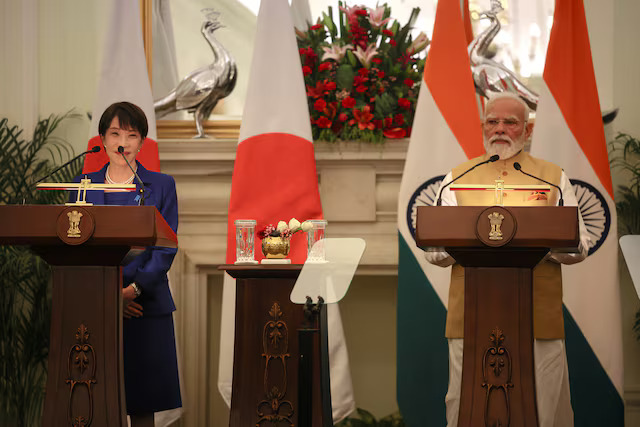
The agreements were finalised following bilateral talks between Prime Minister Narendra Modi and Japanese Prime Minister Sanae Takaichi, who is on a three-day official visit to India. The meeting focused on strengthening cooperation across emerging technologies, trade, investment and regional security amid an increasingly uncertain global environment.
Addressing the media after the talks, Prime Minister Takaichi said India and Japan share complementary strengths that can drive mutual growth and long-term prosperity. She noted that closer cooperation between the two democracies has become even more important as the international landscape continues to evolve.
Prime Minister Modi echoed the sentiment, describing the relationship as one built on trust, shared values and common strategic interests. He said the combination of Japan’s technological expertise and India’s digital and software capabilities has the potential to accelerate innovation, particularly in the field of artificial intelligence.
Among the outcomes of the summit was the adoption of three major cooperation frameworks focused on economic security, energy resilience and AI. The two governments also agreed to prepare a joint roadmap on economic security to enhance supply chain resilience and reduce vulnerabilities in critical sectors.
A significant milestone was the signing of the first-ever India-Japan defence co-development agreement, reflecting the growing security partnership between the two Quad members. The leaders also reviewed cooperation in defence manufacturing, maritime security and regional stability in the Indo-Pacific.
The discussions covered a broad range of issues, including trade, investment, clean energy, emerging technologies and people-to-people exchanges. Both sides reaffirmed their commitment to expanding collaboration in sectors that are expected to shape future economic growth.
Economic ties between the two nations have strengthened steadily in recent years. Bilateral trade reached $27.5 billion during the 2025-26 financial year, while Japanese investments in India remained robust, supported by major infrastructure projects and increasing private-sector participation. Japan continues to be one of India’s largest foreign investors, with ongoing investments in projects such as the Mumbai-Ahmedabad High-Speed Rail corridor and several strategic industries.
Prime Minister Takaichi’s visit follows Prime Minister Modi’s trip to Tokyo last year, during which Japan announced plans to significantly increase its investments in India over the coming decade. Officials from both countries believe the latest agreements will further accelerate cooperation in technology, manufacturing and innovation.
Accompanied by a high-level business delegation, Takaichi is also scheduled to participate in a business conference in New Delhi, where discussions are expected to focus on expanding commercial partnerships and encouraging greater investment opportunities between Indian and Japanese companies.