
 By
By
₹3.25 lakh crore proposal for 114 Rafale jets set for defence ministry review
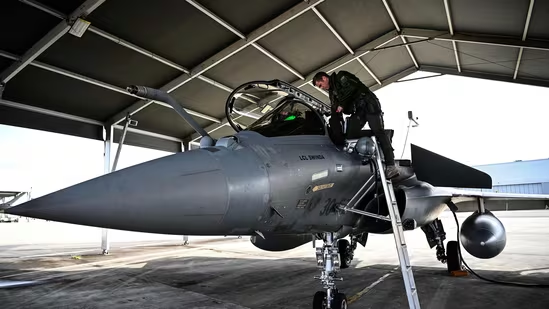
India may be on the cusp of finalising the largest defence acquisition in its history, with the Defence Ministry expected to hold internal deliberations this week on a proposal to procure 114 Rafale fighter jets from France. Valued at approximately ₹3.25 lakh crore, the deal — if cleared — would dramatically reshape the Indian Air Force’s combat capabilities at a time when regional security challenges are intensifying.
The scale of the proposal underlines the urgency facing India’s military planners. With squadron strength falling below sanctioned levels and threats evolving rapidly along both the western and northern borders, the government is under pressure to accelerate fighter induction. The Rafale proposal is being seen within the system as a critical stopgap that bridges operational gaps until indigenous fifth-generation platforms become available in the next decade.
Internal discussions ahead of Cabinet clearance
According to officials familiar with the process, the Defence Ministry will examine the Indian Air Force’s Statement of Case (SoC) for the 114-aircraft acquisition during a high-level meeting scheduled later this week. The proposal, prepared by the IAF and submitted to the ministry several months ago, outlines the operational rationale, cost structure, and industrial roadmap for the acquisition.
Once approved internally, the proposal will be forwarded to the Cabinet Committee on Security (CCS), which has the final authority to clear defence deals of this magnitude. If sanctioned, the purchase would take India’s total Rafale fleet to 176 aircraft — including 36 already in service with the IAF and 26 ordered last year for the Indian Navy.
Also Read – Chinese Communist Party Delegation Meets BJP Leaders in India Amid Thaw in Ties
Mix of direct purchase and domestic manufacturing
The acquisition plan envisages a hybrid model. A limited number — estimated between 12 and 18 aircraft — would be delivered in fly-away condition to meet immediate operational needs. The remaining jets would be manufactured in India, marking a significant expansion of domestic aerospace production under the government’s defence indigenisation push.
However, the deal has drawn attention within policy circles due to its relatively modest indigenous content, pegged at around 30 per cent. This is lower than the 50–60 per cent localisation typically sought under “Make in India” defence programmes. Officials involved in the discussions argue that the urgency of the requirement and the complexity of the platform justify a more flexible approach.
Indian authorities are also pressing France to allow integration of indigenous weapons, avionics, and mission systems into the Rafale platform. While weapon integration is expected to be permitted, the aircraft’s core source codes will remain with the French side under the government-to-government framework.
Why Rafale, despite fifth-generation offers
The timing of the Rafale push is notable, especially as both the United States and Russia have offered their fifth-generation fighter jets — the F-35 and the Su-57 respectively — to India. Despite these overtures, New Delhi appears inclined to stick with the Rafale, citing factors such as operational familiarity, proven performance, and lower integration risks.
Defence planners note that inducting a fifth-generation fighter would require major changes in infrastructure, training, and doctrine, potentially delaying operational readiness. In contrast, the Rafale is already integrated into the IAF’s ecosystem, allowing faster scaling of combat strength.
Recent combat evaluations have further strengthened the Rafale’s case. During Operation Sindoor, the aircraft reportedly demonstrated strong survivability and electronic warfare dominance, particularly against advanced air-to-air threats such as the Chinese-origin PL-15 missile. Its Spectra electronic warfare suite is believed to have played a decisive role in these assessments.
Also Read – Rajnath Singh says borders can change, hints at possibility of Sindh rejoining India.
Industrial footprint and engine MRO plans
Beyond combat capability, the proposed deal carries significant industrial implications. French aerospace major Dassault Aviation is planning to establish a maintenance, repair and overhaul (MRO) facility for Rafale’s M-88 engines in Hyderabad. Such a facility would reduce lifecycle costs, improve aircraft availability, and position India as a regional support hub for Rafale operators.
Dassault has already set up a dedicated entity in India to manage fighter jet maintenance, and Indian aerospace firms — including Tata Advanced Systems — are expected to play a key role in manufacturing and supply chains. Defence officials see this as a step towards building long-term industrial depth, even if the immediate localisation levels are limited.
IAF’s shrinking squadron strength
The backdrop to the Rafale proposal is the Indian Air Force’s declining fighter squadron strength, which has fallen well below its sanctioned level of 42 squadrons. Ageing MiG fleets are being phased out faster than replacements are arriving, creating operational pressure on frontline units.
While India has placed orders for 180 indigenous LCA Tejas Mark 1A jets and continues work on the Advanced Medium Combat Aircraft (AMCA) programme, these platforms will take years to fully stabilise and deploy at scale. Defence planners view the Rafale acquisition as essential to maintaining credible deterrence during this transition period.
Strategic signal to the region
If approved, the ₹3.25 lakh crore Rafale deal would send a strong strategic signal across the region. It would reinforce India’s commitment to maintaining air superiority, deepen defence ties with France, and underscore New Delhi’s preference for reliable, battle-proven platforms over untested alternatives.
As the proposal moves through the decision-making pipeline, it is likely to attract political scrutiny due to its size and long-term financial implications. For the government, however, the calculation appears clear: the cost of delay may be far greater than the price of the jets themselves.