
 By
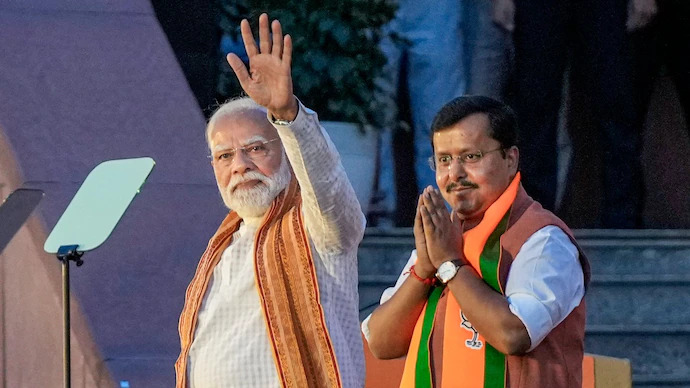
By The BJP’s sweeping victory in West Bengal has triggered more than celebration inside the party — it has sparked a growing belief that party president Nitin Nabin could emerge as one of the key organisational faces behind the party’s next phase of expansion. Within BJP circles, a new narrative is gaining momentum: Nabin is being viewed as a “lucky charm” whose leadership has coincided with some of the party’s most significant gains in eastern India.
The perception strengthened after Prime Minister Narendra Modi publicly praised the BJP’s organisational machinery following victories in West Bengal, Assam and Puducherry. For many party workers, these elections marked the first major political test under Nabin’s tenure as national president — and the results have given the leadership fresh confidence heading into future battles.
While political branding often simplifies deeper realities, BJP insiders say the success in Bengal was not built overnight. The party spent years strengthening booth-level networks, expanding grassroots outreach and building a local leadership structure capable of challenging entrenched regional forces. In that context, leaders like Nitin Nabin are increasingly being credited for focusing on organisational discipline rather than relying only on headline-driven campaigns.
The BJP’s rise in eastern India has always been considered politically difficult. In Bihar, the party had for decades remained dependent on alliance politics and caste equations dominated by regional players. The emergence of a BJP-led government under Samrat Choudhary marked a major strategic shift for the party.
West Bengal posed an even bigger challenge. The dominance of Mamata Banerjee and the Trinamool Congress had long made the state one of the BJP’s toughest electoral battlegrounds. Although the BJP steadily increased its vote share over the years, converting that support into a full electoral victory required sustained groundwork, local mobilisation and long-term cadre building.
Party leaders now argue that Bengal’s victory reflects the BJP’s evolving strategy — one that combines aggressive campaigning with detailed organisational management. The growing focus on local structures, micro-level outreach and disciplined cadre coordination is being projected as a model that could shape the party’s approach in other politically sensitive states as well.
Still, many within the BJP acknowledge that the “lucky charm” tag attached to Nabin is largely symbolic. Political observers point out that states like Bihar and West Bengal remain highly volatile, where caste dynamics, regional identity and local leadership continue to play decisive roles in elections.
The bigger challenge for the BJP now is sustaining momentum. The 2029 Lok Sabha elections are already being seen as the next major test of the party’s eastern strategy. Leaders associated with the BJP’s organisational growth, including Nitin Nabin, are likely to face closer scrutiny as the party attempts to convert recent gains into long-term dominance.
For now, however, Nabin’s growing stature reflects a broader shift inside the BJP — one where organisational strategists are becoming just as important as star campaigners in shaping the party’s future.